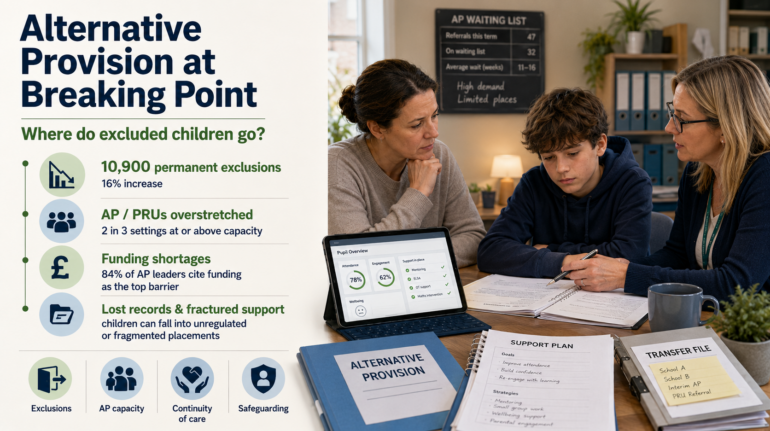
Alternative Provision at Breaking Point: Where Do Excluded Children Go?

Alternative Provision at Breaking Point: Where Do Excluded Children Go?

When a child is permanently excluded from a mainstream school, the legal duty to educate them falls immediately to the Local Authority (LA). The safety net designated for these vulnerable students is the Alternative Provision (AP) sector, predominantly made up of Pupil Referral Units (PRUs). However, across the UK, this safety net is torn. With permanent exclusions skyrocketing - disproportionately affecting children with unassessed or unsupported Special Educational Needs and Disabilities (SEND) - the Alternative Provision sector is operating at a dangerous breaking point, leaving thousands of children adrift in an unregulated void. The Escalating Crisis of Exclusions The scale of the current exclusion crisis in England is unprecedented. According to Department for Education (DfE) data, permanent exclusions across state-funded primary, secondary, and special schools climbed to an alarming 10,900 in a single academic year - a 16% increase from the prior year. This upward surge has shown little sign of abating, with over 3,700 permanent exclusions recorded in the autumn term and another 3,300 in the spring term alone. The most troubling aspect of this surge is its highly dispropor ...
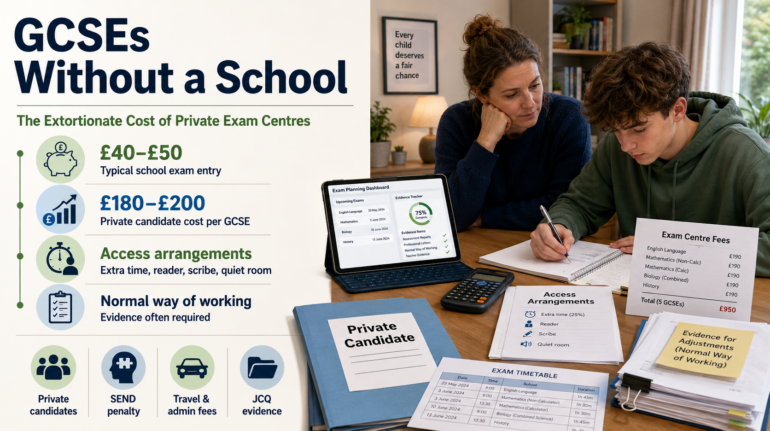

GCSEs Without a School: The Extortionate Cost of Private Exam Centres

GCSEs Without a School: The Extortionate Cost of Private Exam Centres

When a family makes the difficult decision to home educate - often forced by a mainstream system failing to meet their child's Special Educational Needs and Disabilities (SEND) - they are quickly introduced to the hidden financial penalty of alternative pathways: the private exam system. The UK education system is fundamentally built around schools. When a teenager learning at home wishes to sit their GCSEs or A-Levels, they must register as a "Private Candidate". This process exposes an extortionate, inaccessible, and deeply inequitable landscape that effectively prices many vulnerable students out of basic national qualifications. As local authorities monitor elective home education, they frequently emphasise the importance of recognisable qualifications for future prospects; however, the state provides virtually no financial infrastructure to help home-educated students actually access these exams. The Financial Barrier to Entry Within a state school, the cost of entering a student for a GCSE is absorbed by the institution, typically costing the school around £40 to £50 per subject. For a home-educated student, the reality is entirely different, as the financial burden shifts e ...

The Stigma of the 'Unschooler': Breaking Down Stereotypes

The Stigma of the ‘Unschooler’: Breaking Down Stereotypes

Mention "home education" in mainstream circles, and you are likely to encounter one of two pervasive stereotypes: the hyper-academic family replicating school at the kitchen table, or the "unschooler" - often unfairly characterised by the media as permissive parents raising feral, uneducated children. This deep-seated stigma surrounding self-directed learning is not just ignorant; it is actively damaging. It fails to recognise that for many families, particularly those with neurodivergent learners, stepping away from structured curricula and embracing autonomous learning is the key to unlocking profound intellectual and emotional growth. As the UK educational landscape undergoes an unprecedented transition, the rise of elective home education (EHE) demands a more sophisticated analysis. The prevailing cultural narrative frequently treats any departure from the National Curriculum with suspicion, viewing standardised testing as the sole metric of human capability. By examining the cognitive science, legal frameworks, and operational realities of autonomous learning, we can begin to dismantle these reductive biases and reveal the profound efficacy of student-led education. The Philo ...

Are Local Authorities Unlawfully Pushing Back on Deregistrations

Are Local Authorities Unlawfully Pushing Back on Deregistrations?

The right of a parent to electively home educate (EHE) their child is established by Section 7 of the Education Act 1996, which places the responsibility on parents to ensure their child receives an efficient, full-time education suitable to their age, ability, and aptitude. Despite this, reports of Local Authority (LA) obstruction are becoming increasingly frequent, necessitating a clear understanding of the boundary between administrative duty and unlawful overreach. The Legal Reality of Deregistration When a parent decides to home educate, the legal process is relatively simple: they must provide written notice to the Headteacher that the child is receiving education "otherwise than at school". Upon receipt of this notification, the school is legally mandated to remove the child from the admissions register. The school must also notify the Local Authority of the deregistration. Crucial Legal Distinction: Under the Education (Pupil Registration) (England) Regulations 2006, there is no "cooling-off" period, nor is there a statutory requirement for an "exit interview". Asserting that such procedures are mandatory constitutes a misrepresentation of statutory powers. ...

The Rise of EOTAS: Why Education 'Otherwise Than At School' is the New Battleground

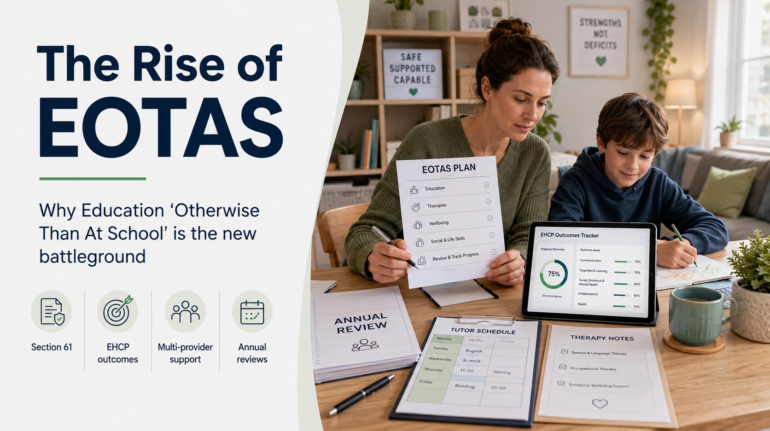
The Rise of EOTAS: Why Education ‘Otherwise Than At School’ is the New Battleground

In the landscape of modern British education, a quiet but profound shift is occurring. For thousands of families navigating the complex world of Special Educational Needs and Disabilities (SEND), the traditional classroom is no longer seen as a place of opportunity, but as a site of potential trauma and systemic failure. As mainstream schools struggle under the weight of funding pressures, overcrowded classrooms, and inflexible behavioural policies, an increasing number of parents are seeking alternative pathways. Among these, Education Otherwise Than At School (EOTAS) has emerged as a high-stakes battleground for children with complex needs. Deep within the Children and Families Act 2014, Section 61 provides the legal foundation for EOTAS. It allows for a child with complex SEND to be educated entirely outside of a traditional school setting. While often confused with Elective Home Education (EHE), EOTAS is fundamentally distinct: it is a legally binding, bespoke package of specialised provision—including 1:1 tutoring, speech and language therapy, occupational therapy, and emotional mentoring—that is commissioned and funded entirely by the Local Authority (LA). However, securing E ...

Home Education Registers: A Necessary Safeguard or State Overreach?

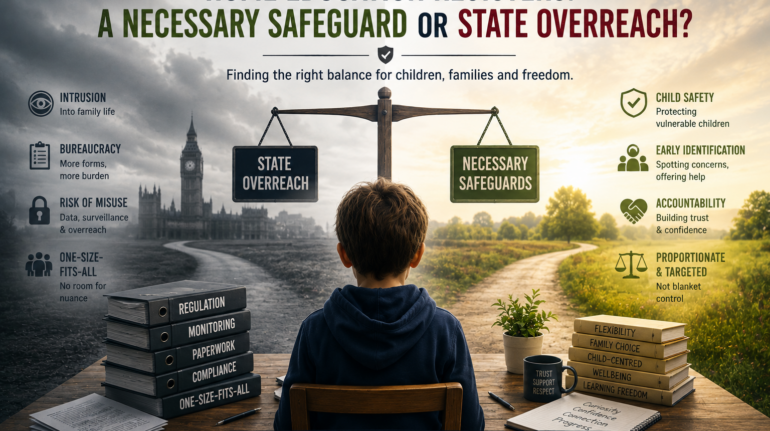
Home Education Registers: A Necessary Safeguard or State Overreach?

The debate surrounding the implementation of a mandatory national register for home-educated children in the UK remains one of the most contentious issues in modern education policy. With the provisions introduced by the Children’s Wellbeing and Schools Act 2026, which mandates that Local Authorities (LAs) maintain a compulsory register of children not in school (CNIS), this debate has moved from theoretical discussion to legislative reality. As families navigate this new landscape, they find themselves caught between the state’s drive for oversight and their own need for autonomy. The Argument for "Safeguarding" Proponents of the register, including many Local Authorities and child protection advocates, frame the policy as a critical safeguarding necessity. Without a mandatory register, LAs claim they cannot accurately track who is being educated at home versus who is entirely missing from education (CME). They argue that a register is a fundamental administrative necessity to ensure that every child is receiving the "suitable education" they are legally entitled to, and to protect children from unregistered, illegal, or unsafe alternative provisions. Their position is built upo ...

The SEN Exodus: How Mainstream Failures Are Driving the Home Schooling Boom

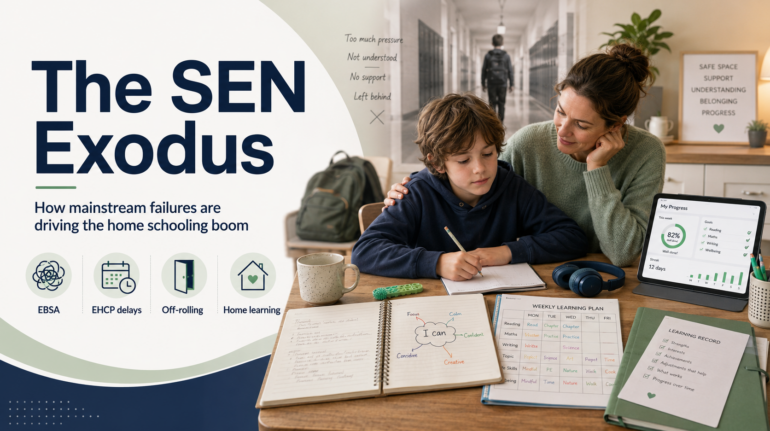
The SEN Exodus: How Mainstream Failures Are Driving the Home Schooling Boom

Over the past five years, the UK has witnessed a dramatic surge in the number of children being educated at home. While historically, home education was often viewed as a niche lifestyle choice, a closer examination of the data reveals a far more troubling reality: for a rapidly growing demographic, it is an act of desperation. Thousands of families are joining what has been aptly termed the "SEN Exodus," pulling their children out of the mainstream education system. Crucially, this mass departure is not born out of an ideological opposition to schooling, but because the system has fundamentally failed to meet their child's Special Educational Needs and Disabilities (SEND). The prevailing narrative of the proactive, affluent home-schooling parent obscures the silent, growing crisis of families who are effectively forced into "elective" home education. These are not families opting out of a functional system; they are being pushed out of a broken one. As the educational landscape becomes increasingly constrained by rigid policies, funding deficits, and new legislative pressures, understanding the root causes and operational realities of this exodus is essential. Core Drivers of the ...