
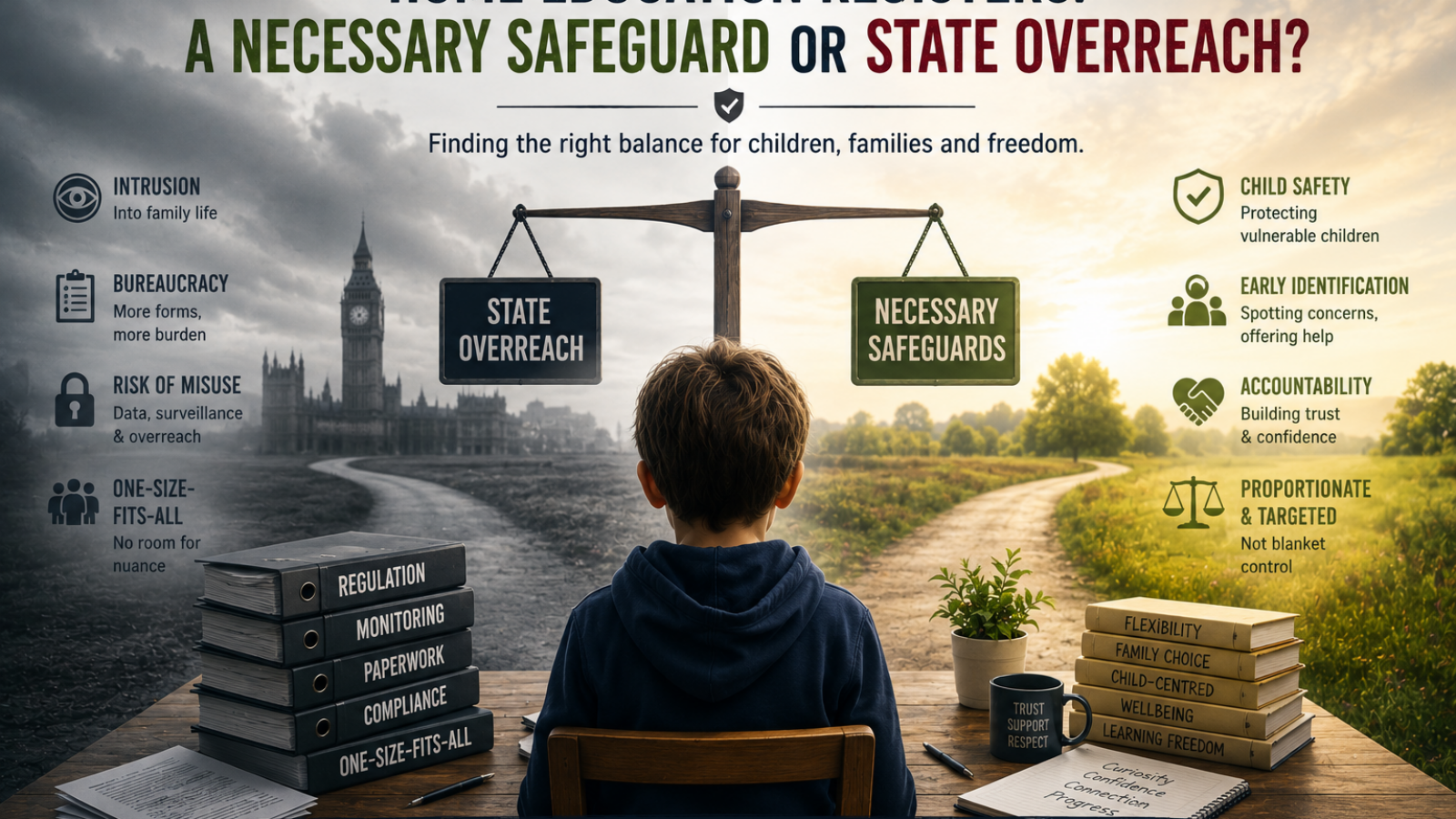
The debate surrounding the implementation of a mandatory national register for home-educated children in the UK remains one of the most contentious issues in modern education policy. With the provisions introduced by the Children’s Wellbeing and Schools Act 2026, which mandates that Local Authorities (LAs) maintain a compulsory register of children not in school (CNIS), this debate has moved from theoretical discussion to legislative reality. As families navigate this new landscape, they find themselves caught between the state’s drive for oversight and their own need for autonomy.
The Argument for “Safeguarding”
Proponents of the register, including many Local Authorities and child protection advocates, frame the policy as a critical safeguarding necessity. Without a mandatory register, LAs claim they cannot accurately track who is being educated at home versus who is entirely missing from education (CME). They argue that a register is a fundamental administrative necessity to ensure that every child is receiving the “suitable education” they are legally entitled to, and to protect children from unregistered, illegal, or unsafe alternative provisions.
Their position is built upon several core administrative and safety-focused arguments:
-
Identifying the “Invisible”: The central thesis is that children who are not enrolled in school are “invisible” to the state, and therefore inherently vulnerable.
-
Tracking Missing Children: LAs argue that without a centralised, compulsory database, it is impossible to accurately distinguish between legitimately home-educated children and those who are entirely missing from education (CME).
-
Ensuring Suitability: Advocates claim that a register is an essential tool to ensure every child receives their legal entitlement to a “suitable education” and to protect them from unregulated, unsafe alternative provisions.
The Fear of State Overreach
For the home education community, particularly families who have withdrawn neurodivergent children from a mainstream system that failed to meet their needs, the register is often perceived not as a safeguard but as a mechanism for state overreach.
-
Hostile Bureaucracy: Families frequently report that LAs overstep their legal bounds by demanding adherence to school-style timetables and standardised testing frameworks that are often antithetical to personalised, neuro-affirming home learning.
-
The “School-at-Home” Bias: There is a deep-seated fear that register monitors will apply a mainstream, deficit-model lens to home education, thereby failing to validate alternative pedagogies such as unschooling or project-based learning.
-
Punitive Risks: Perhaps the greatest anxiety is that non-compliance with arbitrary LA demands could lead to the issuance of School Attendance Orders (SAOs), potentially forcing traumatised children back into the very environments that caused their initial withdrawal.
Navigating Oversight with Proactive Documentation
Regardless of where one stands on the ideological spectrum, the operational reality is that LA scrutiny of home education is increasing. Families need a proactive defence strategy. They must be able to demonstrate the richness and suitability of their educational provision in a language the authorities understand, without compromising their neuro-affirming ethos.
This is exactly the gap E.L.A.H.A fills. E.L.A.H.A provides the digital infrastructure for home educators to take control of their own narrative and evidence base. Rather than operating in isolation, many are using specialised digital infrastructure, such as the E.L.A.H.A platform to document their educational provision.
-
Proactive Compliance: By using digital tools to track learning progress and interventions continuously, parents can present a professional, structured narrative of their education to authorities before a conflict arises.
-
Evidencing “Suitability”: Platforms like E.L.A.H.A allow families to systematically log learning patterns, life skills, and developmental milestones, providing objective evidence that their bespoke approach meets the legal definition of a “suitable education”.
-
Shifting the Power Dynamic: When parents are equipped with robust, chronological data, they can approach interactions with Local Authorities from a position of strength, effectively neutralising vague accusations of neglect or inadequacy.
If mandatory registers are to be the new normal, defensive, data-driven documentation has become the most effective response for families seeking to protect their right to educate their children on their own terms.
Sources & References
-
Department for Education (2026). The Children’s Wellbeing and Schools Act: what parents need to know. The Education Hub.
-
British Psychological Society (2025). Briefing to the House of Lords on the Children’s Wellbeing and Schools Bill.
-
Special Needs Jungle (2025). Children’s Wellbeing and Schools Bill: Protecting children or punishing parents? Special Needs Jungle.
-
Local Government Association (2025). Briefing on the Children’s Wellbeing and Schools Bill, Second Reading.
-
E.L.A.H.A Platform Architecture. Providing operational frameworks for neuro-affirming progress tracking and transparent SEN evidence-logging. Available at: www.elaha.uk.