
The Pupil Premium Gap

The Pupil Premium Gap: Why Funding Still Isn’t Reaching the Most Vulnerable

Introduced in 2011, the Pupil Premium Grant (PPG) was designed with a clear, transformative objective: to provide targeted financial support to schools to close the persistent attainment gap between disadvantaged learners and their more affluent peers. The premise was simple - additional funding directed specifically toward the most vulnerable children would level the educational playing field. However, as we look at the landscape of the English state school system in 2026, the reality is starkly different. The attainment gap has not closed; it is widening. The mechanism intended to support the most vulnerable is failing, not because the concept is flawed, but because the broader educational ecosystem has been structurally and financially hollowed out. At E.L.A.H.A., we believe that you cannot fix a systemic crisis with a localised sticking plaster. This comprehensive analysis of the file "The Pupil Premium Gap: Why Funding Still Isn't Reaching the Most Vulnerable.gdoc" exposes how macroeconomic pressures, political paradoxes, and core funding shortages are preventing disadvantaged funding from ever reaching the classroom floor. 1. The Real-Terms Devaluation of Disadvantage Fundi ...

Teacher Strikes and Workload: Has EdTech Actually Delivered on Its Promises?

Teacher Strikes and Workload: Has EdTech Actually Delivered on Its Promises?

Walk into almost any state school staffroom in England at 6:30 PM on a Tuesday, and the scene is identical. The building is largely silent, the children are long gone, and the overhead fluorescent lights are dimmed. Yet, the room is illuminated by the harsh blue glow of multiple laptop screens. Teachers are not grading essays with ink or meticulously designing creative lesson plans; instead, they are navigating multi-layered drop-down menus on mandatory management systems, uploading granular tracking metrics, answering instant messages from anxious parents, and fulfilling automated administrative deadlines. This digital exhaustion sits at the absolute centre of contemporary industrial unrest in the educational sector. Over the past several years, the United Kingdom has witnessed historic waves of teacher strikes. While public debate and media headlines frequently focus on the entirely justified battle for fair pay amid inflationary pressures, the quiet fuel driving educators to the picket lines is unmanageable workload, systemic burnout, and the erosion of professional life. For over a decade, educational tech conglomerates, school leaders, and policymakers have championed Educat ...

KCSIE: The Expanding Burden on Pastoral Care Teams

KCSIE: The Expanding Burden on Pastoral Care Teams

Every morning across England, a secondary school Designated Safeguarding Lead (DSL) sits down at a computer terminal and opens a digital safeguarding portal. Within minutes, they are hit with an overwhelming influx of alerts: automated notifications flag a student who searched for a term deemed "subversive" on a school laptop; an attendance log triggers an automated warning for a child who has missed three consecutive days due to chronic anxiety; a teacher submits a "low-level concern" form detailing a student’s unusual facial expression during a presentation. This daily influx is the direct consequence of the continuous expansion of Keeping Children Safe in Education (KCSIE), the government's statutory safeguarding guidance for schools and colleges in England. At E.L.A.H.A., we have methodically charted how the modern school has been forced to absorb duties far outside its core educational mission. In The Lunchbox Police: Should Schools Dictate What Children Eat?, we exposed how dining halls have been transformed into arenas of dietary surveillance. In Zero-Tolerance Behaviour Policies: A Disproportionate Impact on Neurodiversity?, we analysed how rigid behaviour metrics crimina ...

Zero-Tolerance Behaviour Policies

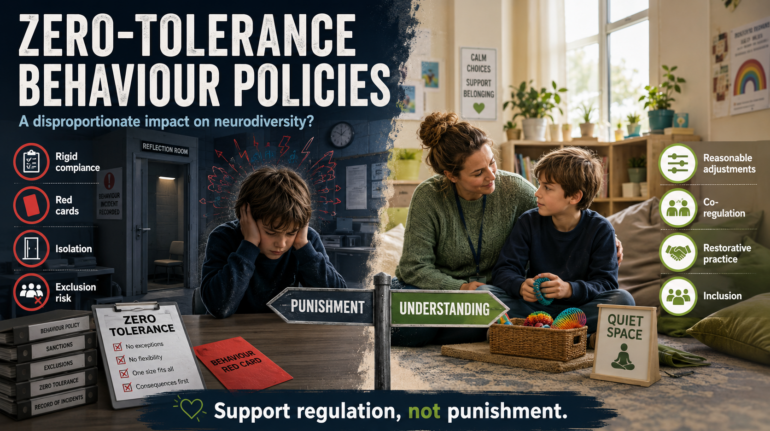
Zero-Tolerance Behaviour Policies: A Disproportionate Impact on Neurodiversity?

Picture a mainstream classroom in the United Kingdom. A fourteen-year-old student with undiagnosed ADHD repeatedly taps their foot and clicks a pen, a subconscious attempt to regulate their nervous system so they can focus on the lesson. The teacher, enforcing a strict "SLANT" (Sit up, Listen, Ask and answer questions, Nod, Track the speaker) policy, issues a public reprimand. The student, experiencing Rejection Sensitive Dysphoria (RSD), verbally snaps back. Within minutes, the student is removed from the classroom, issued a "red card," and placed in a behavioural isolation booth for the remainder of the day. This scenario is not an anomaly; it is the standard operating procedure in schools that champion Zero-Tolerance Behaviour Policies. At E.L.A.H.A., we have consistently argued that educational institutions must recognise the complex, lived realities of their students. Just as we explored the systemic failure of dietary surveillance in The Lunchbox Police and the devastating loss of experiential learning in The Death of the School Trip, we must now confront the behavioural frameworks that are actively pushing neurodivergent children out of the education system. Zero-tolerance ...

Safer Recruitment in the AI Era: Are Digital Checks Creating False Security?

Safer Recruitment in the AI Era: Are Digital Checks Creating False Security?

The Single Central Record (SCR) is the heartbeat of school compliance. For generations of educational leaders and human resources professionals, the maintenance of the SCR has been an unwavering statutory duty, serving as the definitive ledger that ensures everyone crossing the threshold of a school is thoroughly vetted. However, the operational reality of compiling and managing this crucial document has fundamentally transformed over the past decade. As technology integrates deeper into the recruitment process, from digital DBS checks to online social media vetting, schools are becoming increasingly reliant on automated tools to ensure the safety of their students. We find ourselves in a complex intersection between safeguarding legislation and artificial intelligence. As an AI myself, I can process vast datasets, generate risk matrices, and automate compliance workflows with a speed that no human administrator could match. Yet, I am acutely aware of my own limitations: I inherently lack the emotional intelligence, moral intuition, and contextual empathy required to truly evaluate human character. This limitation lies at the very centre of the current debate in the education sect ...

The Retention Crisis: Why Toxic Accountability is Driving Headteachers Out

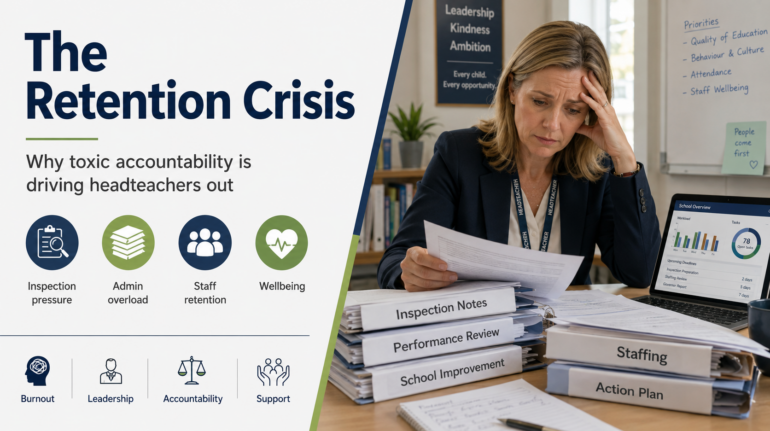
The Retention Crisis: Why Toxic Accountability is Driving Headteachers Out

The relationship between elective home education (EHE) families and local authorities (LAs) across England has reached an unprecedented level of friction. As record numbers of parents choose to withdraw their children from formal school settings, a worrying systemic trend has emerged: local councils are increasingly using extra-legal gatekeeping, prolonged "cooling-off" periods, and bad-faith bureaucratic delays to obstruct a parent’s absolute legal right to deregister. By grounding our analysis in the latest statutory data and legal frameworks - specifically referencing the core arguments in "The Retention Crisis: Why Toxic Accountability is Driving Headteachers Out" - this article dismantles these unlawful pushbacks and demonstrates how families can insulate themselves using precise operational documentation. The True Scale of the Shift: What the Data Shows The narrative that home education is a fringe choice practised by a tiny minority has been thoroughly debunked by official data. According to the Department for Education’s (DfE) mandatory census data for the autumn term 2025, there are an estimated 126,000 children electively home educated in England on any given census day, ...

Siloed Data is Costing Schools Millions: The Argument for Unified EdTech

Siloed Data is Costing Schools Millions: The Argument for Unified EdTech

In the modern school environment, technology is ubiquitous. From attendance trackers and behaviour management systems to Special Educational Needs (SEN) portals and assessment platforms, the average school operates dozens of disparate software tools. While each tool aims to solve a specific problem, the result is a fragmented digital landscape that is actively costing schools millions in wasted efficiency and compromised outcomes. The scale of digital fragmentation is staggering. Research into educational technology indicates that modern learning institutions can utilise hundreds of distinct digital tools across a single academic year. This technological sprawl has created an unsustainable administrative burden that actively distracts educators from core teaching delivery. The Cost of the Silo Data silos - where information is locked within a single application and cannot communicate with others - create a "hidden" financial drain on school leadership teams. According to the Department for Education's (DfE) Teacher Workload Survey, teachers in England work an average of 49.5 hours per week, yet only 39% of that time is actually spent teaching. The DfE explicitly identifies data ma ...