

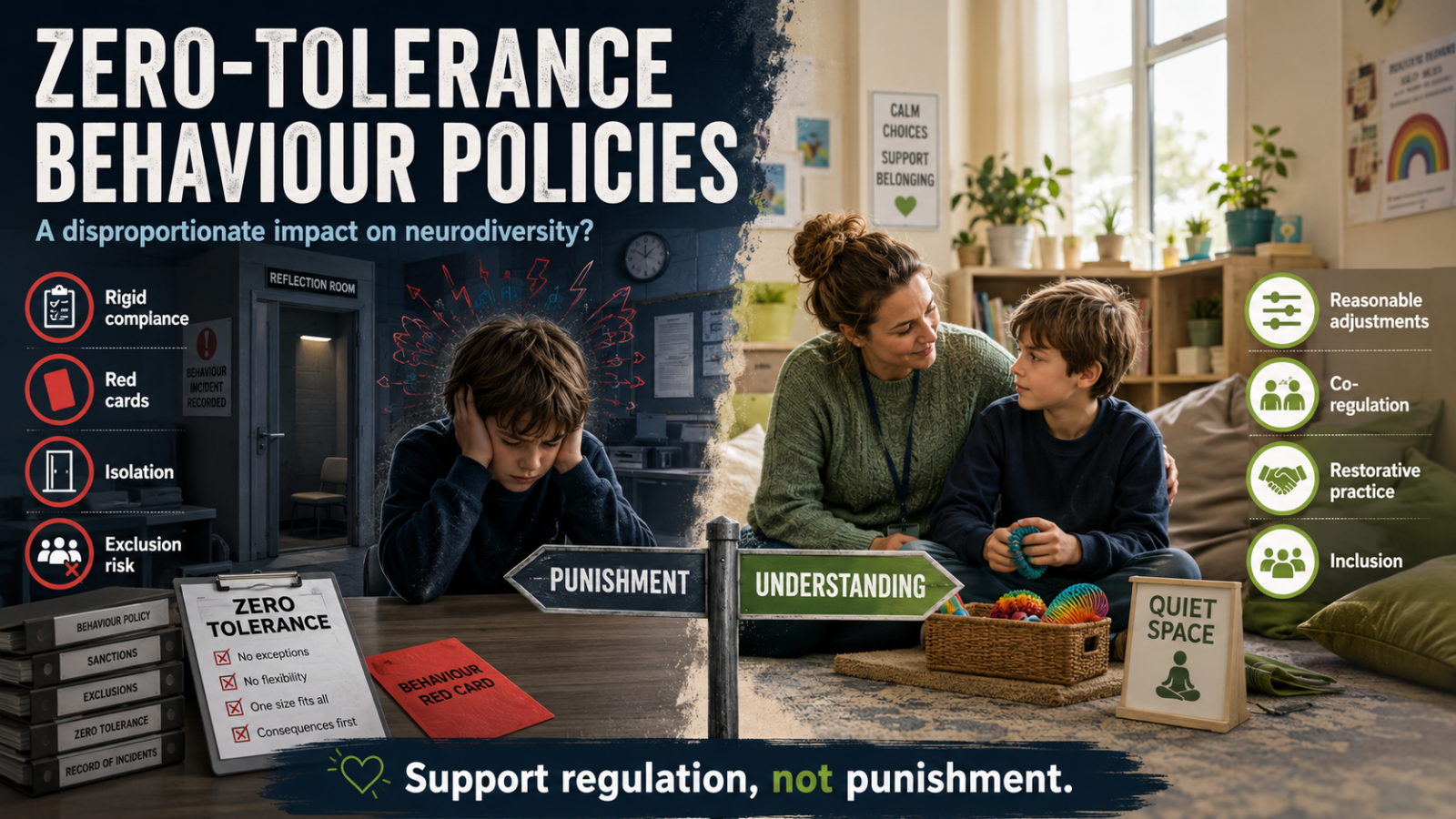
Picture a mainstream classroom in the United Kingdom. A fourteen-year-old student with undiagnosed ADHD repeatedly taps their foot and clicks a pen, a subconscious attempt to regulate their nervous system so they can focus on the lesson. The teacher, enforcing a strict “SLANT” (Sit up, Listen, Ask and answer questions, Nod, Track the speaker) policy, issues a public reprimand. The student, experiencing Rejection Sensitive Dysphoria (RSD), verbally snaps back. Within minutes, the student is removed from the classroom, issued a “red card,” and placed in a behavioural isolation booth for the remainder of the day.
This scenario is not an anomaly; it is the standard operating procedure in schools that champion Zero-Tolerance Behaviour Policies.
At E.L.A.H.A., we have consistently argued that educational institutions must recognise the complex, lived realities of their students. Just as we explored the systemic failure of dietary surveillance in The Lunchbox Police and the devastating loss of experiential learning in The Death of the School Trip, we must now confront the behavioural frameworks that are actively pushing neurodivergent children out of the education system. Zero-tolerance policies – which mandate uniform, predetermined punishments for specific infractions regardless of context – do not create safe, orderly schools. Instead, they create environments where neurological differences are criminalised, misunderstood, and aggressively punished.
1. The Anatomy of Zero-Tolerance
Zero-tolerance policies originated in the 1980s and 1990s as a response to severe behavioural infractions, primarily relating to drugs and weapons in schools. However, over the past two decades, mission creep has taken hold. Today, these draconian frameworks have been adapted to police minor, everyday behaviours: uniform infractions, lack of eye contact, forgetting a pencil, fidgeting, or exhibiting “inappropriate” facial expressions.
The core philosophy of zero-tolerance is absolute compliance. It operates on the assumption that all children possess the exact same executive functioning skills, emotional regulation capacities, and sensory profiles. If a child steps out of line, the punishment is swift, unquestioned, and non-negotiable.
The Illusion of “Fairness”
Proponents of zero-tolerance argue that these policies are inherently fair because they treat every student exactly the same. But treating unequally situated children equally is the very definition of inequity. When a policy demands prolonged stillness, unbroken eye contact, and absolute silence, it privileges the neurotypical brain while setting up the neurodivergent child for inevitable failure.
“Equality is giving everyone the same pair of shoes. Equity is giving everyone a pair of shoes that actually fit. Zero-tolerance policies mandate that every student wear a size 8, and punish those whose feet bleed.”
2. When Neurology is Deemed “Non-Compliant”
To understand why zero-tolerance is so devastating to children with Special Educational Needs and Disabilities (SEND)—particularly those with Autism Spectrum Disorder (ASD), Attention Deficit Hyperactivity Disorder (ADHD), and Pathological Demand Avoidance (PDA)—we must examine how these policies misinterpret neurological distress as willful defiance.
+———————————————————————————–+
| THE MISINTERPRETATION OF NEURODIVERGENT BEHAVIOR |
+———————————-+————————————————+
| Institutional Label (Misbehavior)| The Neuro-Affirming Reality (Neurology) |
+———————————-+————————————————+
| “Refusal to listen” / Disrespect | Auditory processing delays or sensory overload |
| “Fidgeting” / Disruptive | Stimming/movement required for focus |
| “Defiance” / Talking back | Fight/Flight response triggered by demand |
| “Ignoring instructions” | Executive dysfunction / Poor working memory |
| “Inappropriate tone” | Differences in social communication processing |
+———————————-+————————————————+
The Sensory Minefield
For an autistic child, a school environment is often a sensory assault. Fluorescent lights, echoing corridors, the unpredictable physical proximity of peers, and the smell of the dining hall can push their central nervous system to its absolute limits. If an autistic child puts their head on the desk or covers their ears to block out the sensory chaos, a zero-tolerance framework labels this as “off-task behaviour” or “refusal to participate,” leading to detention. The child is punished for attempting to regulate their own distress.
Executive Dysfunction and Memory
Children with ADHD often struggle with working memory and organisation. Forgetting a textbook, losing a piece of homework, or failing to bring the correct colour of pen are hallmarks of executive dysfunction. Under a rigid behaviour policy, these clinical symptoms are recorded as “lack of preparation” or “disobedience,” resulting in demerits. Punishing a child for a neurological deficit is as logical as punishing a visually impaired child for leaving their glasses at home.
3. Meltdown vs. Willful Defiance
Perhaps the most tragic failure of zero-tolerance policies is the complete inability to distinguish between a behavioural choice and an autonomic nervous system response.
When a neurodivergent child is subjected to overwhelming demands, sensory overload, or deep anxiety, they may experience a meltdown. A meltdown is not a temper tantrum. It is not a calculated strategy to manipulate a teacher or avoid work. A meltdown is a physiological loss of control. The child’s brain has perceived a profound threat, and the amygdala has hijacked the prefrontal cortex, throwing the child into an involuntary state of “fight, flight, or freeze.”
Under a zero-tolerance policy, a meltdown is almost always categorised as severe defiance or aggressive behaviour. The typical school response involves shouting, demands for immediate compliance, and threats of exclusion. This authoritarian approach is the equivalent of pouring gasoline on a fire.
- The Escalation Cycle: A teacher demands compliance -> The child’s anxiety spikes -> The child cannot physically comply due to neurological gridlock -> The teacher issues a punishment -> The child enters a full meltdown -> The school issues a formal exclusion.
- The Trauma Response: When schools punish meltdowns, they inflict deep trauma. The child learns that their distress is unacceptable, that their educators are unsafe, and that the school environment is inherently hostile.
4. Isolation Booths: The Architecture of Exclusion
The ultimate weapon in the zero-tolerance arsenal is the isolation booth—often euphemistically branded as “inclusion rooms,” “reflection spaces,” or “consequence units.” These are small, highly restrictive cubicles where students are forced to sit in silence, facing a wall, for hours or even entire days.
The psychological toll of these spaces on neurodivergent children cannot be overstated.
The Damage of Solitary Confinement
Placing a child with ADHD, who requires movement and stimulation to function, into a silent, featureless booth is a form of sensory torture. Placing an autistic child experiencing deep emotional dysregulation into isolation deprives them of the co-regulation and support they desperately need to return to baseline.
Data consistently shows that SEND students are vastly overrepresented in these isolation units. Rather than “reflecting” on their behaviour, children in these spaces often spiral into deeper states of anxiety, self-harm ideation, and school refusal. It is a punitive measure that masquerades as an intervention, entirely devoid of therapeutic or educational value.
5. The Economic Convenience of Compliance
Why do schools rely so heavily on zero-tolerance policies if they are so clearly damaging to SEND students? The answer, as we frequently highlight at E.L.A.H.A., comes down to systemic underfunding and the stripping of resources from the educational sector.
In our analysis of The Death of the School Trip, we highlighted how financial deficits have hollowed out the cultural and experiential elements of education. The same financial crisis drives the behaviour management crisis.
+————————————————————————–+
| THE COST OF BEHAVIOR MANAGEMENT |
+————————————————————————–+
| THE NEURO-AFFIRMING APPROACH | THE ZERO-TOLERANCE APPROACH |
| (High Cost / High Empathy) | (Low Cost / High Authoritarianism) |
+———————————–+————————————–+
| – Highly trained 1:1 SEND staff | – One supervisor in a silent room |
| – Sensory integration spaces | – Blanket, automated punishments |
| – Educational Psychologists | – Tick-box detention tracking |
| – Time for restorative justice | – Instant “red cards” / exclusions |
+———————————–+————————————–+
Zero-tolerance is, fundamentally, cheap. It does not require a teacher to possess a deep, nuanced understanding of neurobiology. It does not require the school to invest in costly Educational Psychologists, specialised SEND coordinators, or bespoke sensory rooms. It simply requires a list of rules and a spreadsheet to track infractions.
Schools are operating under immense pressure to achieve high exam results with ever-shrinking budgets. In this high-stakes environment, compliance is prioritised over comprehension, and order is prioritised over well-being. The neurodivergent child becomes the collateral damage of a financially starved system that can no longer afford to treat children as individuals.
6. The School-to-Prison Pipeline
The consequences of zero-tolerance policies extend far beyond the school gates. By continuously punishing neurodivergent children for their neurology, schools create a cycle of alienation that often leads to permanent exclusion (expulsion).
Statistics consistently reveal that children with Special Educational Needs are significantly more likely to be excluded from school than their neurotypical peers. Once a child is excluded, their life trajectory alters dramatically. They are isolated from their community, deprived of a stable educational foundation, and placed at a significantly higher risk of entering the criminal justice system – a phenomenon widely documented as the “School-to-Prison Pipeline.“
When a school permanently excludes a neurodivergent child for behaviours directly linked to their diagnosis, the school has not solved a behaviour problem; it has simply washed its hands of a vulnerable young person, passing the failure onto the child and their family.
7. Building a Neuro-Affirming Framework
Schools are not prisons, and teachers should not be forced into the roles of wardens. It is entirely possible to maintain a safe, respectful, and effective learning environment without resorting to the cruelty of zero tolerance. Moving forward requires a paradigm shift—from punitive control to Restorative and Neuro-Affirming Practices.
Step 1: Ditch the “One-Size-Fits-All” Model
Schools must accept that true equality means providing different accommodations for different needs. Behaviour policies must include clear, legally binding exemptions for children whose profiles (such as ASD, ADHD, or PDA) make rigid compliance impossible. Reasonable adjustments are not “special treatment”; they are legal rights.
Step 2: Replace Isolation with Co-Regulation
Isolation booths must be abolished. When a student is dysregulated, they do not need solitary confinement; they need connection and co-regulation. Schools must invest in sensory-friendly quiet spaces staffed by trained professionals who understand de-escalation, interoception, and trauma-informed care.
Step 3: Train for Understanding, Not Compliance
Teachers are on the front lines, often doing their best in an under-resourced system. They need robust, ongoing training led by neurodivergent advocates and clinical specialists. Educators must be taught how to distinguish between defiance and dysregulation, how to recognise sensory overload, and how to adapt their environments to prevent meltdowns before they occur.
Step 4: Restorative Justice
When harm is actually done (e.g., property damage or genuine conflict), schools should use restorative justice practices. This involves bringing the affected parties together to understand the impact of the action, repair the relationship, and find collaborative solutions. It teaches accountability through empathy, rather than compliance through fear.
Conclusion: Empathy Over Authoritarianism
The reliance on zero-tolerance behaviour policies represents a profound failure of imagination and empathy within our educational systems. By enforcing rigid, unyielding rules, schools are actively traumatising a generation of neurodivergent children, telling them day after day that their natural way of existing in the world is fundamentally wrong.
At E.L.A.H.A., we demand better. We recognise that teachers are educators, not enforcers, and that schools should be sanctuaries of learning, not arenas of surveillance and punishment. It is time to tear down the isolation booths, throw away the “red cards,” and build an educational framework that accommodates, supports, and celebrates neurodiversity. A truly successful school is not one where every child sits in terrified silence; it is one where every child, regardless of their neurotype, feels safe enough to learn.
References & Sources
- E.L.A.H.A. (2024). The death of the school trip: How funding cuts cost cultural capital. Retrieved from [https://www.elaha.uk/the-death-of-the-school-trip-how-funding-cuts-cost-cultural-capital/](https://www.elaha.uk/the-death-of-the-school-trip-how-funding-cuts-cost-cultural-capital/)
- E.L.A.H.A. (2024). The Lunchbox Police: Should Schools Dictate What Children Eat?
- Department for Education (DfE). (n.d.). Suspension and Permanent Exclusion guidance. GOV.UK. (Data regarding the disproportionate exclusion rates of SEND pupils).
- Hehir, T. (2002). Eliminating Ableism in Education. Harvard Educational Review, 72(1), 1-33.
- Skiba, R. J., & Peterson, R. L. (1999). The Dark Side of Zero Tolerance: Can Punishment Lead to Safe Schools? The Phi Delta Kappan, 80(5), 372-382.
- Porges, S. W. (2011). The Polyvagal Theory: Neurophysiological Foundations of Emotions, Attachment, Communication, and Self-regulation. W. W. Norton & Company. (Context for autonomic nervous system responses and meltdowns).
UK Parliament. (2018). Forgotten children: alternative provision and the scandal of ever-increasing exclusions. House of Commons Education Committee