
When a family makes the difficult decision to home educate – often forced by a mainstream system failing to meet their child’s Special Educational Needs and Disabilities (SEND) – they are quickly introduced to the hidden financial penalty of alternative pathways: the private exam system.
The UK education system is fundamentally built around schools. When a teenager learning at home wishes to sit their GCSEs or A-Levels, they must register as a “Private Candidate”. This process exposes an extortionate, inaccessible, and deeply inequitable landscape that effectively prices many vulnerable students out of basic national qualifications. As local authorities monitor elective home education, they frequently emphasise the importance of recognisable qualifications for future prospects; however, the state provides virtually no financial infrastructure to help home-educated students actually access these exams.
The Financial Barrier to Entry
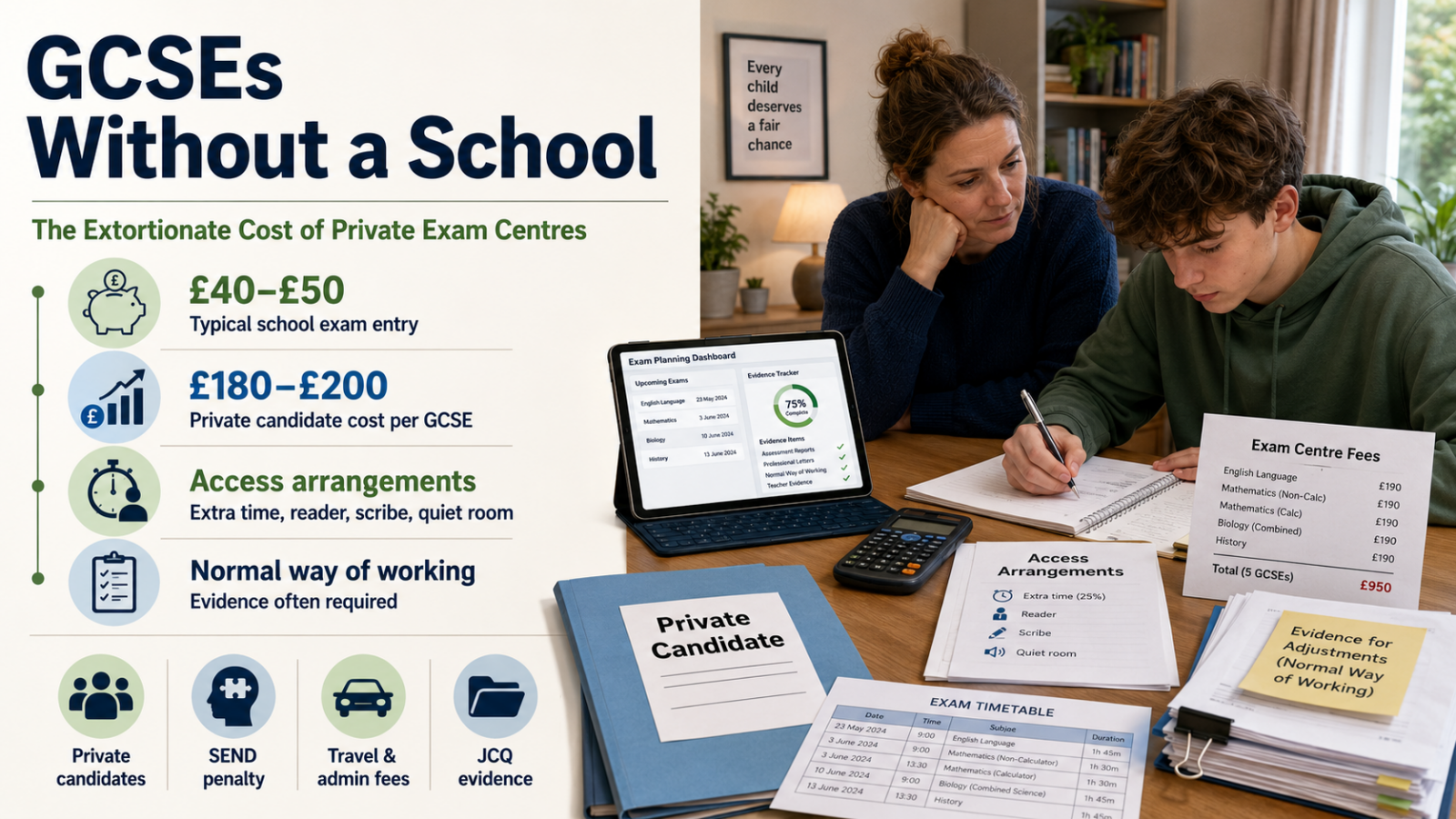
Within a state school, the cost of entering a student for a GCSE is absorbed by the institution, typically costing the school around £40 to £50 per subject. For a home-educated student, the reality is entirely different, as the financial burden shifts entirely onto the family.
- Exam Centre Fees: Private candidates must locate a Joint Council for Qualifications (JCQ) registered exam center willing to take them. These centres charge significant administrative premiums, often pushing the cost of a single GCSE to between £180 and £200, frequently with additional administration costs layered on top.
- Coursework Restrictions: One of the most significant barriers for private candidates is navigating Non-Examination Assessments (NEA). Subjects heavily reliant on coursework or practicals – such as Art, Drama, or the practical endorsements required for Sciences – are frequently impossible for private candidates to access. Many centres refuse to supervise, authenticate, or moderate the work because they have no relationship with the student.
- Geographical Lotteries: Because there is no obligation for an exam centre to accept a private candidate, families often have to travel significant distances. Finding an approved centre early is critical, as deadlines close months in advance and late entries incur substantial financial penalties.
The SEND Penalty
While the base cost of sitting an exam as a private candidate is exorbitant, the most severe injustice falls on neurodivergent learners. The exam system operates under the Equality Act 2010, which mandates that Access Arrangements must be provided so that candidates with disabilities, learning difficulties, or medical conditions are not unfairly disadvantaged.
However, securing these rights outside of a traditional school structure introduces what is effectively a “SEND penalty”.
- The Cost of Assessment: Arranging Special Educational Needs Access Arrangements – such as 25% extra time, a reader, a scribe, a word processor, or a separate quiet room – requires independent specialist assessment. Parents are frequently forced to pay hundreds of pounds out of pocket for a private Educational Psychologist or a Specialist Assessor report just to validate their child’s needs.
- Administrative Surcharges: Even after a family secures an independent medical or psychological assessment, exam centres frequently charge extra administrative fees to facilitate these necessary accommodations. Hiring a dedicated scribe or invigilator for a separate room adds direct hourly costs to the family’s final exam bill.
Proving the “Normal Way of Working”
The greatest bureaucratic hurdle for neurodivergent private candidates is satisfying the strict regulations set by the Joint Council for Qualifications (JCQ). To approve an Access Arrangement, the JCQ demands a history of evidence showing that the requested accommodation is the student’s “normal way of working.”
In a traditional school, a Special Educational Needs Coordinator (SENCo) compiles this evidence organically over the years, tracking how a student uses a word processor in lessons or requires supervised rest breaks during mock exams.
For a home-educated student, generating this formally recognised evidence trail is a logistical nightmare. The normal way of working within an exam centre is a critical issue because the centre has no previous relationship with the home-educated candidate. If a parent requests that their child type their exam instead of hand-writing it, the centre needs concrete evidence that typing is the student’s usual method of completing written work. Because many families struggle to provide evidence in a format that exam centres recognise, neurodivergent students are frequently forced to sit gruelling exams without the adjustments they desperately need and legally deserve.
How E.L.A.H.A Supports the Private Candidate
While legislative reform is desperately needed to cap exam costs for home educators and standardise access, families must navigate the current reality today. Establishing a rigorous, chronological evidence base is critical. This is where E.L.A.H.A becomes an invaluable tool for the teenage home educator.
E.L.A.H.A is built to support neuro-affirming education operations, providing families with a structured way to build the exact portfolios exam boards and assessors require. By utilising E.L.A.H.A., families can bridge the gap between their home environment and the JCQ’s rigid evidentiary standards:
- Document Access Needs: Families can keep consistent, timestamped evidence of the interventions and adjustments used during daily learning over a period of years. Whether it is logging the use of a laptop for long-form writing or tracking the frequency of sensory breaks, this data firmly establishes the “normal way of working”.
- Track Academic Progress: Parents can compile professional, structured learning records that demonstrate the student’s capability, commitment, and readiness for the exam. This documentation is crucial when negotiating with private centres that may be hesitant to accept outside candidates.
- Collaborate with Assessors: E.L.A.H.A allows parents to seamlessly share the child’s learning history and documented needs with independent Educational Psychologists or SENCo assessors. This objective data speeds up the assessment process, ensuring reports meet JCQ requirements on the first attempt.
No child should be priced out of their qualifications because their neurological needs require them to learn at home. The transition from school to elective home education should be a pathway to recovery and personalised learning, not a gateway to financial extortion. Until the examination system is modernised to equitably support private candidates, technological intervention is a family’s strongest defense. E.L.A.H.A helps families build the undeniable evidence they need to fight for fair access to the exam hall, ensuring that neurodivergent learners can achieve their qualifications on an even playing field.
Sources & References
- Original E.L.A.H.A Insight Documentation: GCSEs Without a School: The Extortionate Cost of Private Exam Centres.
- Joint Council for Qualifications (JCQ). Access Arrangements and Reasonable Adjustments. Guidelines detailing the requirement for “normal way of working” and evidence of need for private candidates.
- Sandwell Metropolitan Borough Council. Elective Home Education Welcome Pack for Parents. Public guidance notes that while schools absorb £40-£50 per exam, private candidates face fees of £180-£200 plus administrative costs.
- Exam Centre London. Exam Access Arrangements for Private Candidates in London. Independent centre guidance outlining the necessity of establishing a history of need for home-educated learners requesting scribes or word processors.
- Ed Yourself. Exams Access Arrangements. Home education legal advocacy detailing the lack of obligation for exam centres to accept private candidates and the complexities of the Equality Act 2010.