
When a child is permanently excluded from a mainstream school, the legal duty to educate them falls immediately to the Local Authority (LA). The safety net designated for these vulnerable students is the Alternative Provision (AP) sector, predominantly made up of Pupil Referral Units (PRUs).
However, across the UK, this safety net is torn. With permanent exclusions skyrocketing – disproportionately affecting children with unassessed or unsupported Special Educational Needs and Disabilities (SEND) – the Alternative Provision sector is operating at a dangerous breaking point, leaving thousands of children adrift in an unregulated void.
The Escalating Crisis of Exclusions
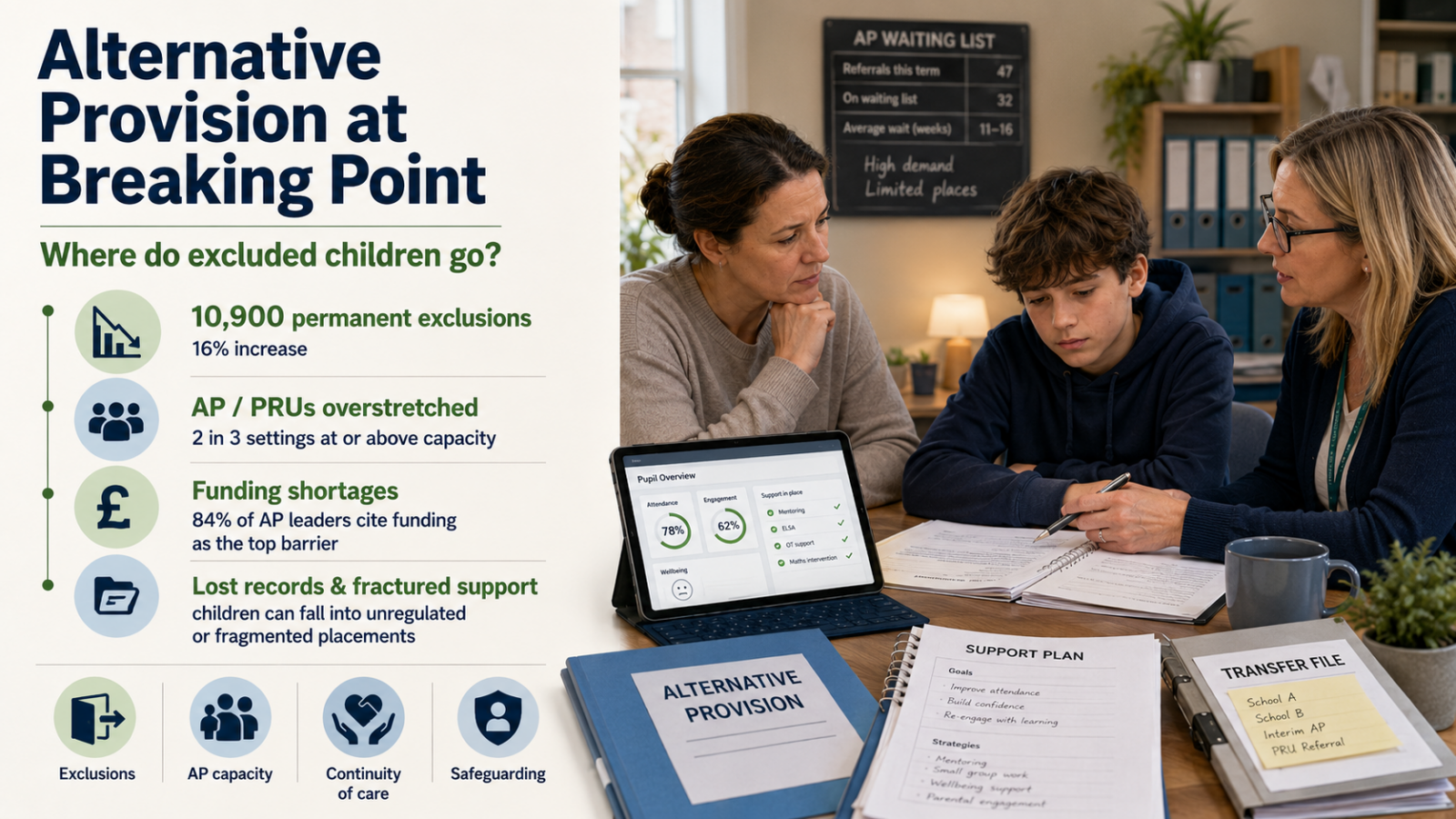
The scale of the current exclusion crisis in England is unprecedented. According to Department for Education (DfE) data, permanent exclusions across state-funded primary, secondary, and special schools climbed to an alarming 10,900 in a single academic year – a 16% increase from the prior year. This upward surge has shown little sign of abating, with over 3,700 permanent exclusions recorded in the autumn term and another 3,300 in the spring term alone.
The most troubling aspect of this surge is its highly disproportionate target demographic. Rather than functioning as an equal-opportunity disciplinary measure, permanent exclusions are overwhelmingly concentrated among vulnerable, socioeconomically disadvantaged, and neurodivergent learners.
Permanent Exclusion Risks by Pupil Characteristics
| Pupil Group | Permanent Exclusion Rate (per 10,000 pupils) | Relative Risk Assessment |
| No Identified SEN | 2 | Baseline rate |
| Pupils with EHC Plans | 9 | 4.5x more likely to face permanent exclusion |
| Pupils on SEN Support | 12 | 6x more likely to face permanent exclusion |
| Free School Meal (FSM) Eligible | 10 | 5x more likely to face exclusion than non-eligible peers |
The reality behind these figures is clear: the system is systematically excluding the very children who require the most intensive support. Persistent disruptive behaviour remains the most common justification used by schools, accounting for 38% of all permanent exclusions. Yet, external research and legal advocacy groups frequently point out that “disruptive behaviour” is almost always the outward manifestation of unmet, unassessed neurodivergent needs – such as autistic burnout, ADHD impulsivity, or severe learning difficulties – clashing with rigid, zero-tolerance school environments.
Alternative Provision at the Brink
Pupil Referral Units and state-funded AP schools were originally conceived as short-term, intensive interventions. The goal was to temporarily extract a struggling student from a mainstream classroom, stabilise their mental health, provide targeted behavioural or learning strategies, and smoothly reintegrate them back into mainstream education.
Today, that rehabilitative pipeline is completely gridlocked. Due to the sheer volume of exclusions, PRUs have been forced to transform into permanent holding pens for displaced youth.
A Systemic Overload: A landmark report by the Children’s Commissioner found that two-thirds of state-funded special schools and Alternative Provision settings are currently operating at or above their physical capacity.
This capacity crisis is compounded by severe, systemic underfunding and resource strain. According to the same national census, 84% of AP leaders cite acute funding shortages as their absolute top barrier to delivering adequate support to students—a figure significantly higher than the 51% reported by mainstream headteachers. Furthermore, over half (54%) of AP settings are facing critical staffing and recruitment shortages, leaving them without the specialist teachers, therapists, and allied healthcare professionals required to support highly complex children.
The Danger of the Void: The Rise of Unregulated Placements
When a local authority cannot find a vacancy in a registered, state-funded PRU due to overcrowding, its statutory obligation to provide full-time education from the sixth day of exclusion does not vanish. To cope with this impossible mathematical equation, LAs are increasingly forced to turn to the private, non-state-funded, and sometimes entirely unregulated sector.
House of Commons Library research reveals that local authority-funded placements within non-state-funded alternative provisions skyrocketed by a staggering 156%. While this category includes highly specialised independent schools, it also encompasses an expansive, fragmented grey market of unregistered providers:
- Vocational Farms and Workshops: Well-meaning but often educationally limited day programs focusing strictly on manual labour or animal care, lacking a robust academic curriculum.
- Fragmented Online Tutors: Displaced children assigned to basic online learning platforms with minimal human interaction, left to sit isolated in front of computer screens.
- Library Supervised Sessions: Vulnerable teenagers are met by temporary support workers in local libraries for just a few hours a week, a practice that directly violates statutory mandates for full-time education.
The Phenomenon of “Lost Records”
The most immediate casualty of this fragmented journey is the child’s administrative and developmental data. When a student bounces between mainstream exclusions, part-time timetables, off-site directions, and short-term private AP placements, their educational history is routinely shattered.
Crucial documentation – such as speech and language assessments, occupational therapy guidelines, specific behavioural triggers, and even active statutory files – frequently vanishes into an administrative black hole. The statutory 15-day window for schools to transfer a Common Transfer File (CTF) is routinely delayed or ignored during chaotic transitions. As a direct result, AP staff and independent tutors are forced to start completely from scratch, entirely blind to the evidence-based strategies that actually help the child regulate and learn.
The Societal and Human Cost of Systemic Failure
Shunting a highly traumatised, neurodivergent child experiencing acute sensory overload into an overcrowded, understaffed PRU designed for disciplinary correction does not fix the issue; it exacerbates the trauma. The long-term outcomes for children trapped within this broken alternative provision pipeline are devastatingly poor:
- Academic Failure: Only 1 in 27 pupils (3.7%) who finish Key Stage 4 in an alternative provision achieve a passing grade of 4 or above in GCSE English and Mathematics, compared to roughly 2 in 3 (65%) pupils in the general population.
- Long-term Unemployment: More than 2 in 3 AP pupils are verified to be completely missing from sustained education, apprenticeships, or employment five years after leaving school, leaving them highly vulnerable to economic isolation.
- The Prison Pipeline: Parliamentary committee evidence highlights a direct, systemic link between school exclusion and criminal justice involvement. It is estimated that 63% of the entire prison population in England and Wales were permanently excluded from school during their childhood.
The Digital Bridge: Deploying E.L.A.H.A for Continuum of Care
If the physical infrastructure of the Alternative Provision sector is fractured, families and progressive educators must rely on robust digital tools to ensure a child’s safety, history, and development are never lost. This is precisely where deploying an advanced workspace like E.L.A.H.A becomes critically vital.
E.L.A.H.A serves as a secure, portable, and completely decentralised infrastructure for a child’s educational profile. By removing the reliance on slow-moving local authority networks and disjointed school registers, it empowers parents and multi-agency professionals to maintain a continuous, unassailable thread of care.
1. An Unbroken Portable Profile
E.L.A.H.A allows parents to hold, manage, and instantly share an immutable digital record of their child’s complete educational journey. Whether the child is in a mainstream school, under a temporary off-site direction, attending a vocational PRU, or working with a private tutor, their learning history, communication preferences, and progress tracking remain organised in a single dashboard.
2. Evidencing Neuro-Affirming Strategies
Instead of letting a new AP setting guess a child’s needs through trial and error, parents can use E.L.A.H.A to showcase of historical, strengths-based indicators. The platform can directly catalogue past sensory triggers, successful de-escalation strategies, and specific learning adjustments (such as typing preferences or necessary sensory breaks). This data instantly guides new educators, neutralising the risk of restrictive physical practices or isolation rooms.
3. Safeguarding the EHCP Assessment Process
For excluded children undergoing statutory assessment for an Education, Health and Care Plan (EHCP), placement instability is the leading cause of multi-month delays. E.L.A.H.A allows parents to continuously log chronological, objective evidence of a child’s needs and interventions across multiple temporary environments. This portfolio can be seamlessly handed to independent Educational Psychologists or LA SENCos, ensuring the statutory assessment process remains perfectly on track despite physical location changes.
A Legal and Ethical Imperative
The recent updates embedded within national statutory frameworks – including strengthened DfE restrictions on unlawful “off-rolling,” strict definitions regarding managed moves, and mandatory inclusions of the “pupil voice” in off-site directions – prove that the state is acutely aware of the systemic abuses occurring at the fringes of mainstream education.
However, policy adjustments on paper mean very little to an excluded child sitting on a waiting list for a non-existent PRU place. Excluded children are fundamentally the most vulnerable learners in the country. Until structural funding and capacity match the escalating realities of the SEND crisis, families must proactively insulate their children. By pairing absolute legal awareness with a rigorous, data-driven approach via E.L.A.H.A, home educators and protective professionals can shield displaced children from institutional trauma and secure the personalised, dignified education they legally deserve.
Sources & References
- Department for Education (2025). Suspensions and permanent exclusions in England: Spring Term 2024/25. Explore Education Statistics. Available at: GOV.UK
- House of Commons Library (2025). Alternative education provision in England. Research Briefing CBP-10617. Available at: commonslibrary. parliament.uk
- Children’s Commissioner for England (2024). Special schools and alternative provision settings are fighting an uphill battle. Commissioner’s School Census Report. Available at: childrenscommissioner.gov.uk
- UK Parliament Committees (2018). Written Evidence on Alternative Provision (ALT0033). Available at: committees.parliament.uk
- Department for Education (2025). Suspensions and permanent exclusions in England: Autumn Term 2024/25. Explore Education Statistics. Available at: GOV.UK
E.L.A.H.A Platform Architecture. Operational frameworks for neuro-affirming progress tracking and continuous educational evidence-logging. Available at: www.elaha.uk