
In the landscape of modern British education, a quiet but profound shift is occurring. For thousands of families navigating the complex world of Special Educational Needs and Disabilities (SEND), the traditional classroom is no longer seen as a place of opportunity, but as a site of potential trauma and systemic failure. As mainstream schools struggle under the weight of funding pressures, overcrowded classrooms, and inflexible behavioural policies, an increasing number of parents are seeking alternative pathways. Among these, Education Otherwise Than At School (EOTAS) has emerged as a high-stakes battleground for children with complex needs.
Deep within the Children and Families Act 2014, Section 61 provides the legal foundation for EOTAS. It allows for a child with complex SEND to be educated entirely outside of a traditional school setting. While often confused with Elective Home Education (EHE), EOTAS is fundamentally distinct: it is a legally binding, bespoke package of specialised provision—including 1:1 tutoring, speech and language therapy, occupational therapy, and emotional mentoring—that is commissioned and funded entirely by the Local Authority (LA).
However, securing EOTAS is a complex legal process characterised by bureaucratic hurdles and systemic resistance. As families fight to ensure their children receive the tailored education they are entitled to, understanding the legal framework and operational realities of EOTAS is essential.
The Legal Threshold: A High Bar to Clear
Securing an EOTAS package is a rigorous legal challenge. Unlike a standard school placement, parents must meet a high legal threshold: they must prove that it is “inappropriate for the provision to be made in any school.”
This requirement often forces families into high-stakes SEND Tribunals. Local Authorities, concerned by the financial implications of funding bespoke, out-of-school packages, frequently gatekeep this provision. To prevail, parents must invest significant time and resources into gathering independent evidence from educational psychologists, psychiatrists, and therapists to demonstrate that forcing their child into a school building would cause acute psychiatric harm or severe learning regression.
The Operational Challenge: Managing Bespoke Provision
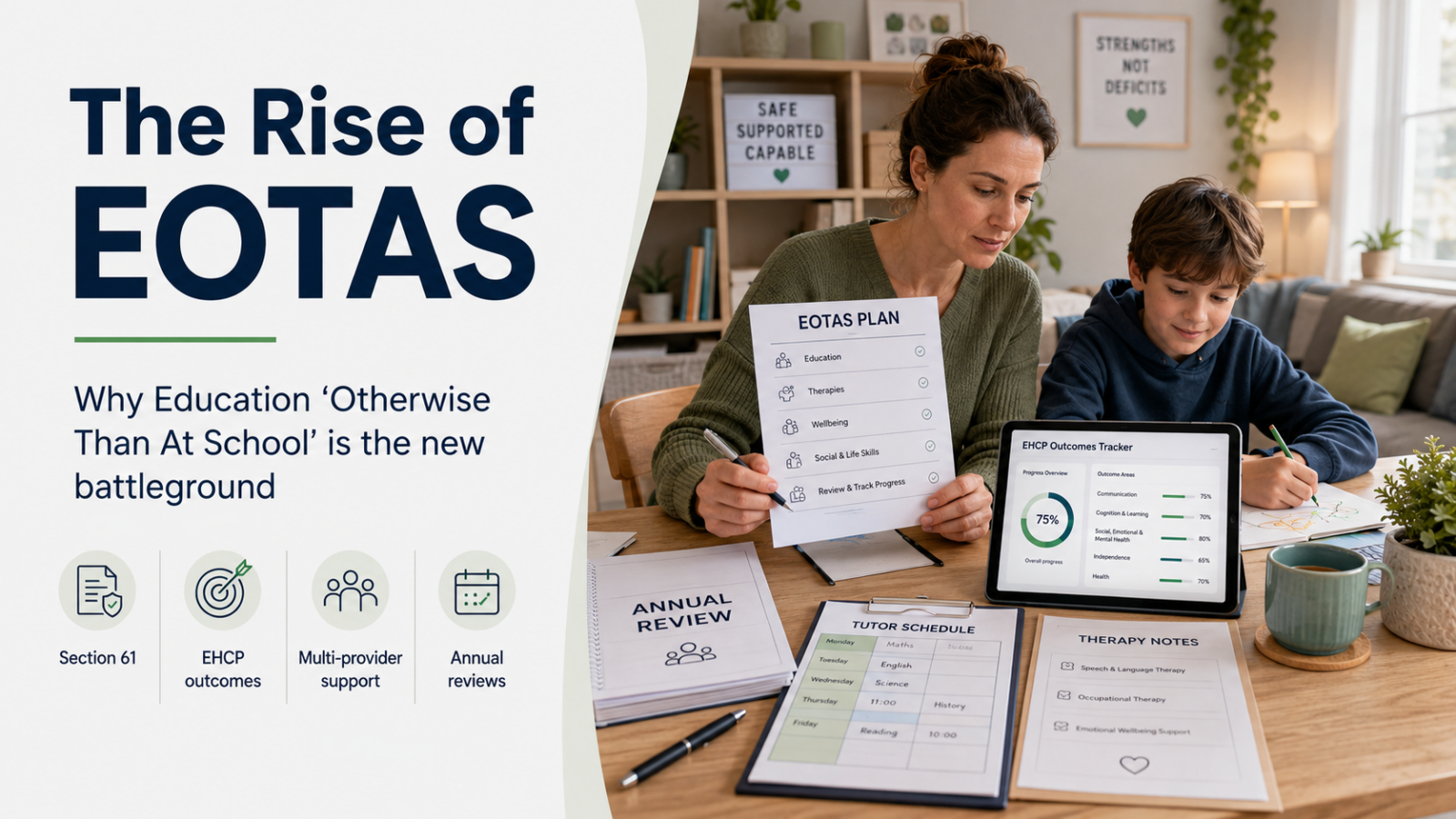
If a family successfully secures an EOTAS package, they are immediately met with a new operational challenge. Unlike a school, which provides centralised administrative and pastoral support, an EOTAS provision is decentralised by nature. A child might have a math tutor on Monday, an occupational therapist on Thursday, and emotional mentoring on Friday.
In this environment, the parent often becomes the coordinator of the child’s educational team. They are responsible for:
-
Coordinating Professionals: Managing the schedules and integration of multiple independent tutors and therapists.
-
Tracking Statutory Outcomes: Ensuring that all interventions align with the legal requirements outlined in Section F of the child’s Education, Health and Care Plan (EHCP).
-
Reporting and Compliance: Preparing comprehensive, data-backed reports for the Local Authority’s Annual Review process, which determines whether the EOTAS package continues to be funded.
Centralising EOTAS Management with E.L.A.H.A
The fragmented nature of EOTAS makes data tracking a significant hurdle. Without a centralised system, keeping track of progress across multiple providers can become chaotic, making it difficult to demonstrate the effectiveness of the package to the Local Authority. This is the operational void where digital infrastructure is becoming essential.
By moving from manual logs and disparate communications to a centralised digital workspace, families can:
-
Unify the Team: Provide a secure, centralised dashboard where independent tutors, therapists, and parents can collaboratively log progress against specific EHCP outcomes.
-
Track Holistic Indicators: Move beyond academic metrics to document crucial, evidence-based interventions in self-regulation, sensory integration, and emotional well-being.
-
Automate the Evidence Base: Effortlessly compile longitudinal data to prove that the EOTAS package is achieving its objectives, ensuring that funding is protected and renewed during Annual Reviews.
Winning the legal fight for EOTAS is a milestone, but delivering and proving the impact of that provision is the key to a child’s long-term success. By equipping themselves with professional-grade management tools, families can reduce the administrative burden and ensure their child’s unique educational journey is supported by clear, indisputable data.
Sources & References
-
Children and Families Act 2014. Section 61: Education otherwise than at school. Available at: legislation.gov.uk
-
Department for Education (2025). SEND Code of Practice: 0 to 25 years. Statutory guidance for organisations that work with and support children and young people with special educational needs and disabilities. Available at: GOV.UK
-
IPSEA (2023). Education otherwise than at school (EOTAS). Independent Provider of Special Education Advice (IPSEA) guidance on the legal test and Section 61 applications. Available at: ipsea.org.uk
-
Surrey County Council (2023). Education Other than at School (EOTAS) – Local Offer. Guidance on policy, the legal test of “inappropriateness,” and the difference between EOTAS and EHE. Available at: surreycc.gov.uk
-
Amaze Sussex (2023). EOTAS: Education Otherwise Than At School – Information Sheet. An analysis of Section F vs. Section I in EHCPs for EOTAS packages. Available at: amazesussex.org.uk
-
E.L.A.H.A Platform. Digital infrastructure for neuro-affirming progress tracking and transparent SEN evidence-logging for bespoke educational provisions. Available at: www.elaha.uk