
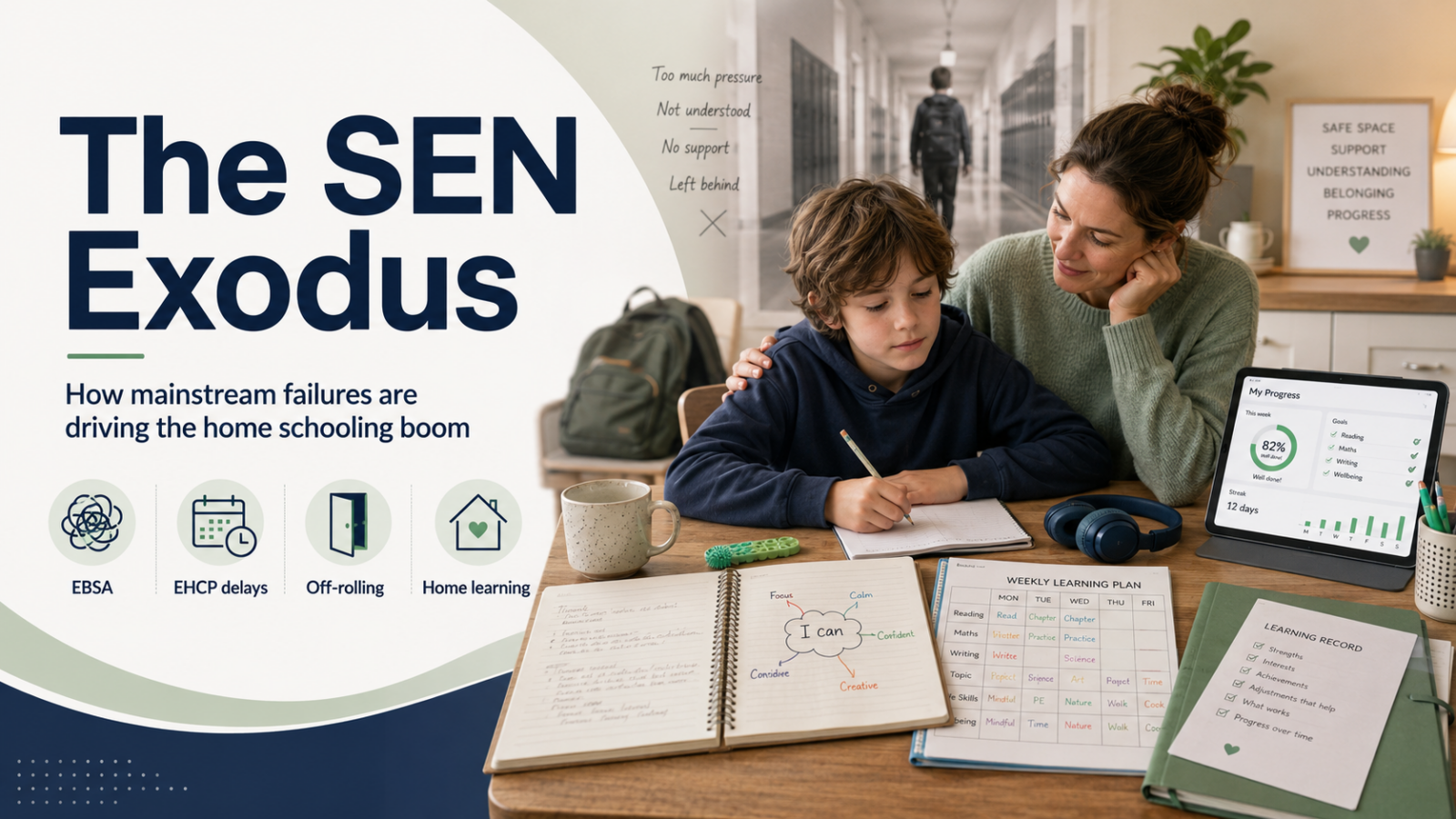
Over the past five years, the UK has witnessed a dramatic surge in the number of children being educated at home. While historically, home education was often viewed as a niche lifestyle choice, a closer examination of the data reveals a far more troubling reality: for a rapidly growing demographic, it is an act of desperation. Thousands of families are joining what has been aptly termed the “SEN Exodus,” pulling their children out of the mainstream education system. Crucially, this mass departure is not born out of an ideological opposition to schooling, but because the system has fundamentally failed to meet their child’s Special Educational Needs and Disabilities (SEND).
The prevailing narrative of the proactive, affluent home-schooling parent obscures the silent, growing crisis of families who are effectively forced into “elective” home education. These are not families opting out of a functional system; they are being pushed out of a broken one. As the educational landscape becomes increasingly constrained by rigid policies, funding deficits, and new legislative pressures, understanding the root causes and operational realities of this exodus is essential.
Core Drivers of the Exodus
The transition from mainstream schooling to home education is rarely a sudden or frivolous decision. Instead, it is typically the culmination of months, or even years, of systemic failure, trauma, and unheeded advocacy. The primary drivers behind this exodus include a confluence of psychological, bureaucratic, and cultural barriers within mainstream settings.
1. Emotionally Based School Avoidance (EBSA) Mainstream school environments are frequently ill-equipped to accommodate the sensory and neurological profiles of all children. Emotionally Based School Avoidance (EBSA) is a significant driver, disproportionately affecting Autistic, ADHD, and highly anxious learners. These students frequently experience severe burnout stemming from overwhelming sensory environments and inflexible behaviour policies. EBSA is not mere “truancy” or defiance; it is a profound psychological and physiological response to an environment that feels unsafe or intolerable. When schools enforce rigid compliance over psychological safety, neurodivergent children are pushed into a state of chronic distress, making attendance a daily trauma rather than an educational opportunity.
2. EHCP Denials, Delays, and Systemic Deficits. For children requiring statutory support, an Education, Health and Care Plan (EHCP) is theoretically the mechanism to secure necessary accommodations. In practice, families find themselves languishing on multi-year waiting lists for statutory assessments, leaving their children entirely unsupported in mainstream classrooms during crucial developmental windows. The special educational needs and disabilities (SEND) system in England has faced unprecedented pressure over the past decade, resulting in immense delays in getting assessments and forcing many parents into drawn-out legal battles against local authorities (Sibieta & Snape, 2024). When children are left in holding patterns without funding, specialist intervention, or modified curricula, the burden of their unmet needs falls squarely on the child’s well-being, inevitably accelerating the path toward school avoidance.
3. Off-Rolling and Exclusion Threats Perhaps the most insidious driver of the SEN exodus is the practice of off-rolling and the weaponisation of exclusions. There is often subtle (and sometimes overt) pressure from schools suggesting a child might be “happier at home”. This is frequently a calculated manoeuvre by educational institutions to avoid the statistical stain of permanent exclusion on their records. Research highlights that the likelihood of being permanently excluded is heavily associated with unmet special educational needs (SEN) or disability, and there is considerable concern regarding “hidden” forms of exclusion like managed moves and off-rolling within the UK system (Daniels et al., 2022). Children with SEND, alongside those with a history of social care, are disproportionately at risk of being pushed out of English state schools entirely (Jay et al., 2022).
When the educational environment becomes toxic, parents are left with an impossible choice: continue subjecting their child to daily trauma within a hostile institution, or sacrifice their own careers and income to become full-time educators.
The Accidental Home Educator: Challenges vs. Realities
The romanticised view of homeschooling rarely applies to the SEND community. Families thrust into home education overnight face a monumental operational hurdle. This transition represents a profound shift in identity and responsibility; parents must instantly transition from advocates to educators.
The Operational Challenge
Unlike traditional home educators who may spend months researching pedagogy and curating resources, “accidental” home educators must immediately design, deliver, and document an entire curriculum tailored to complex neurodivergent profiles. They are tasked with achieving this while simultaneously managing their child’s recovery from school-induced trauma and burnout.
The Legislative and Bureaucratic Paradox
Compounding this operational stress is the looming pressure of local authority oversight. The traditional tools of mainstream schooling—rigid timetables, standardised testing, and deficit-focused reporting—are exactly what drove these children away in the first place. Yet, Local Authorities still demand proof of a “suitable education,” leaving parents scrambling to find ways to track progress without recreating the traumatic environment their children just escaped.
This tension is only exacerbated by recent legislative developments. For instance, the Children’s Wellbeing and Schools Act 2026 mandates that Local Authorities maintain a compulsory register of children not in school (CNIS). While the stated intent is to identify vulnerable children slipping through the cracks, this translates to increased surveillance and profound anxiety for SEND families. Critics and advocacy groups fear this data-gathering exercise could lead to the invasive monitoring of families who have removed their children from schools precisely due to unmet SEND needs. Parents who have sacrificed their livelihoods to protect their children’s mental health are now forced to continually justify their choices against metrics designed for neurotypical, mainstream cohorts.
Operational Realities and the Role of Technology
The central tension of the SEN exodus lies in the gap between the complex reality of neurodivergent learning and the rigid compliance metrics demanded by the state. How does a parent prove educational progression for a child who requires a completely non-linear, trauma-informed approach to learning?
This is exactly where digital innovation, such as the E.L.A.H.A platform steps in to bridge the gap. E.L.A.H.A is intentionally being built to support neuro-affirming education operations specifically tailored for alternative pathways and home education contexts. For families navigating the turbulent waters of the SEN exodus, E.L.A.H.A provides a vital digital lifeline. Practically, it transforms the operational reality of the accidental home educator in several profound ways:
-
Track Progress on Their Terms: Instead of forcing neurodivergent children into the mould of a restrictive national curriculum grades, the platform allows parents to move away from standardised testing. It empowers them to track learning through holistic, strengths-based indicators, such as visualising, exploring, and self-regulation.
-
Build Bulletproof Evidence: The burden of proof placed on home-educating parents is immense, particularly when challenging local authorities. The platform enables parents to keep structured, chronological evidence of learning, adjustments, and interventions. This level of detailed, objective data is crucial when responding to Local Authority inquiries or building a robust case for an EHCP assessment.
-
Facilitate Proactive Collaboration: The isolation of home education is a significant risk factor for parental burnout. Technology can bridge this by seamlessly sharing progress and strategies with consented professionals—like speech and language therapists or educational psychologists—in a secure, transparent workspace. By fostering a unified space for communication, these tools can move the relationship away from suspicion and surveillance, and toward a model of genuine, shared responsibility.
-
Ensure Data Integrity: Rather than relying on burdensome manual registers that reduce a child to binary metrics of attendance or non-attendance, integrated platforms help ensure that the data reported accurately reflects a child’s true support needs and progress.
Conclusion
The SEN exodus is a damning indictment of the mainstream education system. It exposes a systemic failure to protect, support, and educate the most vulnerable children in the UK, forcing parents to choose between their child’s psychological safety and their own socioeconomic stability. As legislative efforts like the Children’s Wellbeing Bill push for stricter attendance tracking and surveillance, the fundamental issues of underfunding and inflexible environments remain painfully unaddressed.
However, amidst this systemic failure, there is a testament to parental resilience. For those families bravely forging a new path outside the traditional classroom, technology is proving to be the great equaliser. Platforms like E.L.A.H.A provides the necessary operational tools to ensure that their home education journey is structured, legally validated, and above all, genuinely neuro-affirming. Until mainstream schools are resourced and reformed to be truly inclusive, the home-schooling boom will continue not as a trend, but as a necessary sanctuary.
References
Daniels, H., Porter, J., & Thompson, I. (2022). What Counts as Evidence in the Understanding of School Exclusion in England? Frontiers in Education, 7. https://doi.org/10.3389/feduc.2022.929912 Cited by: 30
Jay, M. A., Grath-Lone, L. M., De Stavola, B., & Gilbert, R. (2022). Evaluation of pushing out of children from all English state schools: Administrative data cohort study of children receiving social care and their peers. Child Abuse & Neglect, 127, 105582. https://doi.org/10.1016/j.chiabu.2022.105582 Cited by: 17
Sibieta, L., & Snape, D. (2024). Spending on special educational needs in England: something has to change. The IFS. Cited by: 12