
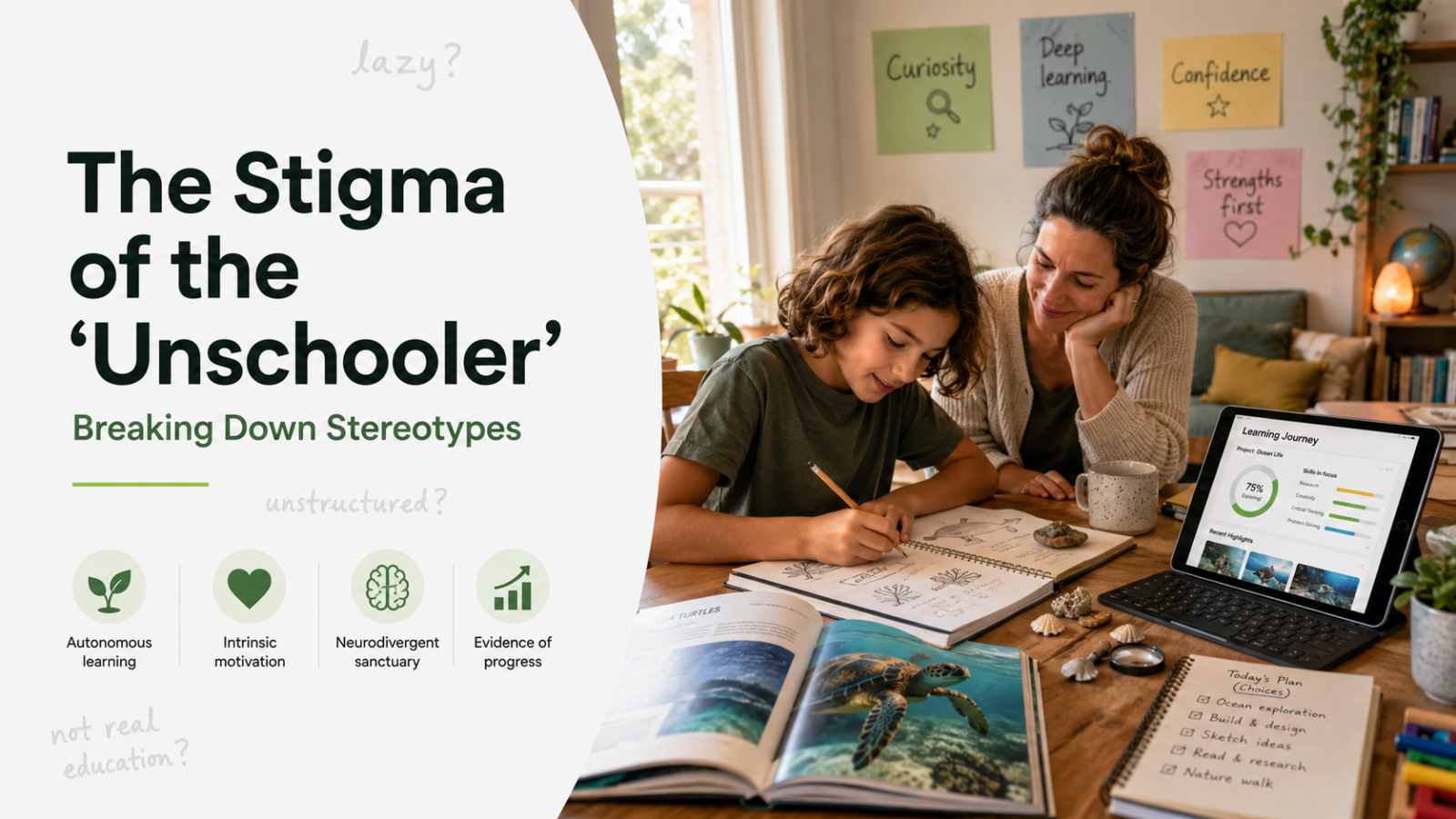
Mention “home education” in mainstream circles, and you are likely to encounter one of two pervasive stereotypes: the hyper-academic family replicating school at the kitchen table, or the “unschooler” – often unfairly characterised by the media as permissive parents raising feral, uneducated children. This deep-seated stigma surrounding self-directed learning is not just ignorant; it is actively damaging. It fails to recognise that for many families, particularly those with neurodivergent learners, stepping away from structured curricula and embracing autonomous learning is the key to unlocking profound intellectual and emotional growth.
As the UK educational landscape undergoes an unprecedented transition, the rise of elective home education (EHE) demands a more sophisticated analysis. The prevailing cultural narrative frequently treats any departure from the National Curriculum with suspicion, viewing standardised testing as the sole metric of human capability. By examining the cognitive science, legal frameworks, and operational realities of autonomous learning, we can begin to dismantle these reductive biases and reveal the profound efficacy of student-led education.
The Philosophy of Autonomous Learning
Unschooling, or autonomous learning, is rooted in the belief that children are naturally curious and will learn best when driven by their own interests, rather than an arbitrarily imposed timetable. This approach is not a modern fad; it is anchored in decades of educational philosophy and developmental psychology, drawing heavily from the work of pioneers like John Holt and contemporary researchers like Peter Grey. It represents the ultimate departure from the “deficit model” of education, which views the child as an empty vessel requiring systematic filling, or an inherently flawed individual requiring constant remediation.
In a traditional setting, educational success is often reduced to compliance and memorisation. Conversely, autonomous learning capitalises on intrinsic motivation – the gold standard of cognitive engagement. According to Self-Determination Theory, formulated by psychologists Edward L. Deci and Richard M. Ryan, human learning and psychological well-being are maximised when individuals experience autonomy, competence, and relatedness. When an individual’s education is self-directed, their brain processes information through pathways dedicated to deep, long-term conceptual integration, rather than transient, test-oriented short-term memory.
The practical application of this philosophy completely reframes what “counts” as instruction:
-
Instead of forcing a dyslexic child to endure hours of agonising phonics drills, an unschooling approach might allow them to develop their literacy through coding, graphic novels, or building complex LEGO architecture.
-
Learning happens organically through life: managing a budget at the supermarket, deeply researching a hyper-fixation on marine biology, or developing entrepreneurial skills through a passion project.
By allowing the child’s natural cognitive processing style to dictate the medium of instruction, autonomous learning transforms education from a source of friction into an organic extension of human development.
The Neurodivergent Sanctuary: Regulating the Nervous System
For autistic children, those with ADHD, or those suffering from profound educational trauma, the mainstream classroom is frequently an environment of chronic sensory and emotional overload. The constant pressure to mask autistic traits, conform to rigid neurotypical standards of behaviour, and perform under the threat of punitive disciplinary measures can plunge a child into a perpetual state of fight-or-flight.
For these learners, the removal of the pressure to perform to neurotypical standards allows their nervous systems to regulate, paving the way for genuine engagement. When a highly anxious or traumatised child is removed from an environment causing Emotionally Based School Avoidance (EBSA), a prolonged period of “deschooling” is often required. During this phase, learning cannot and should not resemble traditional schooling.
Neurological research indicates that the brain’s prefrontal cortex – the seat of executive functioning, critical thinking, and emotional regulation – cannot function effectively when a child is under chronic stress. By removing the arbitrary milestones of the standardised classroom, autonomous learning provides the psychological safety necessary for a child’s nervous system to heal. Once regulated, the child’s natural curiosity inevitably returns, driving them to pursue deep learning experiences that are both intellectually rigorous and emotionally sustainable.
The Translation Problem
Despite its profound clinical and developmental benefits, autonomous education exists within a rigid legislative framework that often struggles to comprehend non-traditional pedagogies. The fundamental issue unschoolers face is a “translation problem”. Under Section 7 of the Education Act 1996, parents are legally required to ensure their children receive an efficient, full-time education suitable to their age, ability, and aptitude. Crucially, UK law does not state that this education must follow the National Curriculum or look anything like a school classroom.
However, a systemic disconnect occurs during interactions with local government. When Local Authorities demand to see a “curriculum,” they are looking for math worksheets and literacy grades. Their administrative infrastructure is built entirely around linear tracking, standardised benchmarks, and deficit-focused metrics. Consequently, they struggle to quantify the immense educational value of a child spending three days designing a Minecraft server economy.
To an experienced educator or an economist, building a Minecraft server involves sophisticated applied mathematics, system administration, asset allocation, conflict resolution, and digital literacy. To an untrained Local Authority officer operating with a school-at-home bias, it looks like unstructured screen time. This communication gap carries severe consequences: if unschoolers cannot translate their child’s self-directed learning into bureaucratic language, they risk facing accusations of educational neglect and the threat of School Attendance Orders. This leaves families vulnerable to aggressive state intervention simply because their evidence of suitability does not mirror a traditional classroom.
Bridging the Gap with E.L.A.H.A
How do you measure the immeasurable? How do you track a non-linear, passion-led education without killing the joy of it? This is exactly where platforms like E.L.A.H.A become revolutionary for the self-directed learning community. E.L.A.H.A provides the digital architecture to translate unschooling into undeniable evidence of progress, serving as a professional translator between organic, child-led learning and the structured accountability required by Local Authorities.
Rather than forcing parents to abandon their pedagogical principles and adopt rigid testing models, the platform enables families to preserve their educational autonomy while building an unassailable evidentiary base:
-
Document Experiential Learning: Families can log project-based achievements, life skills, and hyper-focus deep dives, mapping them cleanly against broader developmental milestones.
-
Track Strengths-Based Indicators: The platform allows parents to prove that the child is developing critical skills like “Exploring,” “Visualising,” and “Complex Problem Solving,” even if they aren’t sitting traditional exams.
-
Maintain Autonomy: It enables parents to keep consistent, structured evidence of the child’s educational journey in a neuro-affirming way that satisfies legal oversight without forcing the child back into a rigid curriculum.
By shifting the tracking paradigm from a deficit model to a strengths-based model, technology allows parents to compile longitudinal, professional portfolios. When an LA review occurs, instead of offering defensive anecdotes, parents can present an organised dashboard of clear progress. This protects the family from bureaucratic overreach while validating the child’s unique, non-linear educational path.
Conclusion
It is time to break the stigma. Unschooling is a valid, powerful educational pathway, and with tools like E.L.A.H.A, families finally have a way to showcase their child’s unique brilliance to a world still obsessed with standardised testing. The caricature of the unschooled child as uneducated or neglected is an outdated stereotype that ignores both modern cognitive science and the lived realities of thousands of thriving families.
As mainstream environments increasingly struggle to accommodate the diverse neurological and emotional needs of the student population, autonomous learning should not be viewed as an eccentric outlier. It is a highly effective model of personalised, trauma-informed education. By pairing the freedom of child-led learning with robust digital management tools, home educators can successfully protect their legal rights, satisfy statutory oversight, and empower their children to achieve deep, authentic excellence on their own terms.
Sources & References
-
Education Act 1996, Section 7. The duty of parents to secure the education of children of compulsory school age. London: HMSO. Available at: legislation.gov.uk
-
Department for Education (2019). Elective home education: Departmental guidance for local authorities. Government guidelines outlining LA monitoring duties and parental rights. Available at: GOV.UK
-
Gray, P. (2013). Free to Learn: Why Unleashing the Instinct to Play Will Make Our Children Happier, More Self-Reliant, and Better Students for Life. New York: Basic Books.
-
Deci, E. L., & Ryan, R. M. (2000). The “What” and “Why” of Goal Pursuits: Human Needs and the Self-Determination of Behaviour. Psychological Inquiry, 11(4), 227-268. Available via: Taylor & Francis Online
-
Holt, J. (1989). Learning All the Time. Cambridge: Da Capo Press.
-
Preece, D., & Howley, M. (2018). An exploration of the emotional and physiological impact of school environments on autistic learners. European Journal of Special Needs Education, 33(4), 511-525.
-
E.L.A.H.A Platform Architecture. Providing specialised digital workflows for autonomous, strengths-based learning documentation and Local Authority compliance mapping. Available at: www.elaha.uk