
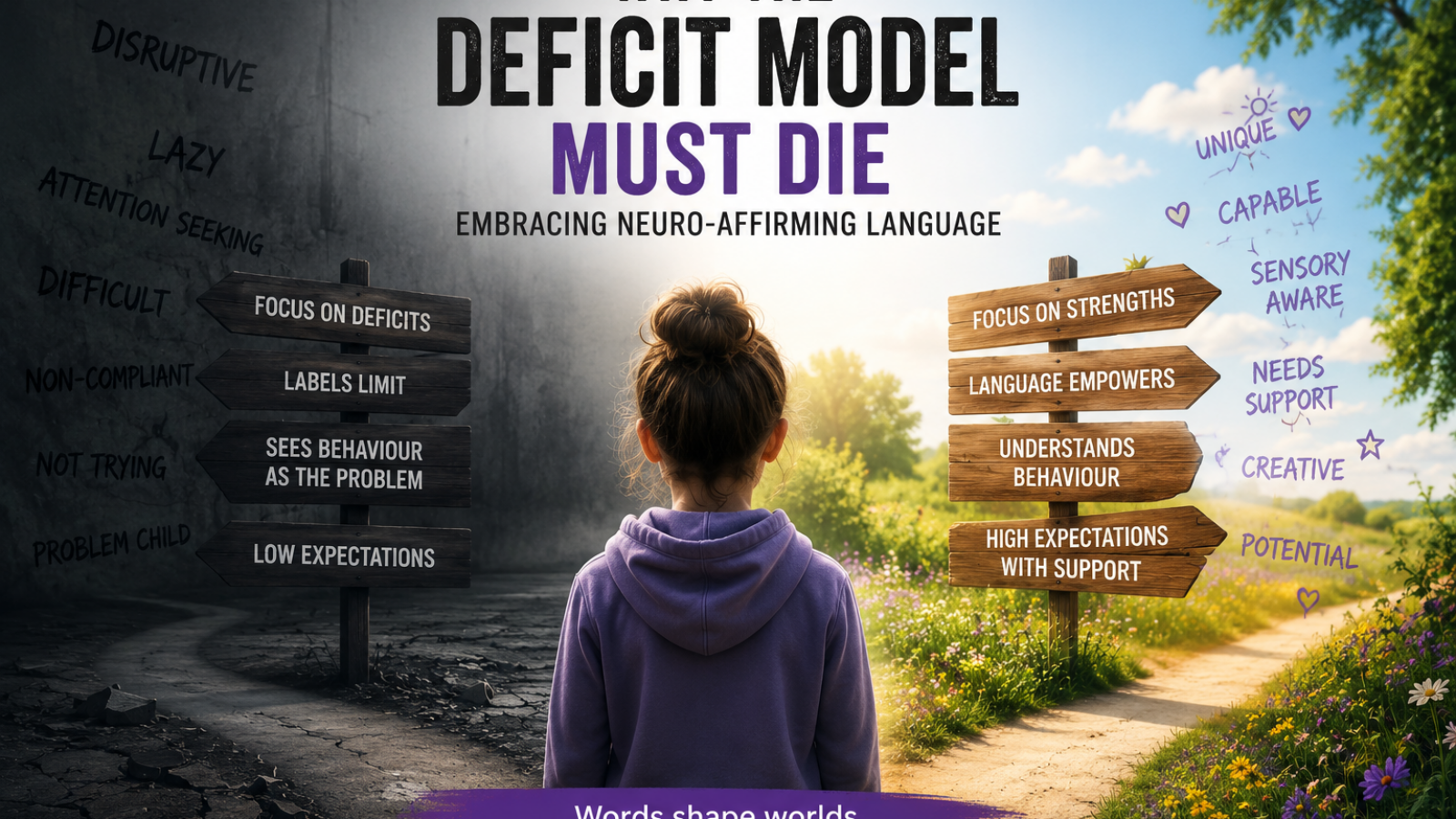
For generations, the realm of special education has been fundamentally defined by what a child cannot do. If we look closely at the language embedded deep within our educational infrastructure – from Individualised Education Programmes (IEPs) and Education, Health and Care Plans (EHCPs) down to termly report cards – it is overwhelmingly rooted in a “deficit model”.
This outdated paradigm views neurodivergent traits (like those inherently found in Autism, ADHD, Dyspraxia, and Dyslexia) primarily as disorders. It pushes a damaging, medicalised narrative that these natural cognitive variations are clinical errors that need to be fixed, managed, or mitigated so the child can approximate a “neurotypical” standard. Ultimately, it is a framework that systematically erodes a child’s self-esteem from a very young age and actively obscures their immense cognitive potential.
Currently, the British Psychological Society and various UK educational authorities estimate that at least 1 in 7 people in the United Kingdom is neurodivergent. With such a massive segment of the student population possessing distinct, highly valuable cognitive architectures, clinging to an archaic framework of “deficits” is no longer just pedagogically unsound; it is a systemic failure of duty. To build a modern, inclusive education system, the deficit model must be entirely dismantled and replaced with neuro-affirming operational practices.
The Anatomy of the Deficit Model in Modern Classrooms
The deficit model does not just exist in the abstract; it dictates the operational reality of how schools measure success. Mainstream UK schooling heavily relies on standardisation. It disproportionately values sitting still, rote memorisation, rapid processing of written instructions, and unbroken eye contact. When a neurodivergent learner naturally struggles to conform to these highly specific, rigid metrics, the system categorises them as failing.
When a learner’s educational profile is dominated by clinical phrases such as “fails to,” “struggles with,” “lacks,” and “is unable to,” they quickly internalise a deeply destructive narrative of inherent failure. Their entire educational existence becomes a list of shortcomings. Traditional SEND registers frequently operate as catalogues of brokenness, detailing everything a child cannot achieve rather than mapping out the unique ways in which their brain successfully processes the world.
This environment inadvertently weaponises a child’s neurobiology against them. When behavioural support plans focus on “reducing non-compliance” rather than identifying the sensory or academic triggers causing the distress, the school is treating the symptom while ignoring the child’s basic psychological safety.
The Devastating Psychological Impact of Deficient Language
This constant pathologising of neurodivergent learners has severe, life-altering consequences. Educational psychologists and disability justice advocates point to three major psychological crises actively perpetuated by the deficit model:
1. The Exhaustion of Masking and Autistic Burnout
Because the educational environment signals that their natural state is “wrong” or “disordered“, neurodivergent children exhaust themselves trying to hide their natural ways of being to fit typical expectations, leading directly to severe burnout. This process is known as “masking.”
Recent research into masking – including prominent UK studies funded by the National Autistic Society – highlights the devastating toll this takes. Masking involves the manual, conscious effort to suppress natural self-regulation behaviours (like stimming) and force neurotypical social performances (such as maintaining painful eye contact or suppressing sensory discomfort). Over time, this extreme cognitive load results in profound physical and mental exhaustion, a fracturing of the child’s core identity, and significantly elevated rates of clinical anxiety and suicidal ideation. Masking is not a sign of successful integration; it is a trauma response to an unaccommodating environment.
2. Learned Helplessness
When the primary feedback loop a child receives is overwhelmingly negative, they develop “Learned Helplessness.” Students simply stop trying because the system continually confirms they are “broken“. If an ADHD student’s working memory challenges are constantly highlighted as a “failure to follow instructions,” rather than supported with visual scaffolding, the child learns that their effort is futile. They internalise their systemic friction as a permanent, personal incompetence, completely detaching themselves from the learning process.
3. Systemically Lowered Expectations
Educators inadvertently set significantly lower academic and creative ceilings for students defined only by their challenges. When a child’s profile only speaks to their delayed processing speed or phonetic reading difficulties, teachers may subconsciously restrict their access to complex problem-solving tasks, advanced science, or creative writing. This creates a self-fulfilling prophecy of academic underachievement, entirely missing the exceptional divergent thinking, pattern recognition, and lateral problem-solving skills that neurodivergent minds naturally possess.
The Neuro-Affirming Shift: Changing the Narrative
Fortunately, a thought-leadership revolution is occurring across the global education sector. Central to this movement is the neurodiversity paradigm, which asserts that neurological differences are simply natural human variations, not clinical errors. Just as society recognises the vital necessity of biodiversity in nature, we must recognise the necessity of cognitive diversity in our classrooms.
This paradigm shift absolutely demands a new language. To become truly inclusive, schools must adopt neuro-affirming practices. This means fundamentally presuming competence in every learner and recognising that behaviour is communication. By adopting neuro-affirming language, we stop trying to fix the child and start focusing entirely on fixing the environment.
A practical shift in institutional vocabulary can transform a child’s educational trajectory. Consider the stark differences outlined below:
| Deficit Model Language | Neuro-Affirming Language |
| “Suffers from autism / is a dyslexia sufferer.” | “Is autistic / is a dyslexic learner.” |
| “Challenging behaviour / non-compliant.” | “Distressed behaviour indicating an unmet need.” |
| “Fixations or obsessions.” | “Special interests or intense passions.” |
| “Lacks social skills / refuses to engage.” | “Communicates differently / requires a different social environment.” |
| “Attention deficit / easily distracted.” | “Interest-driven nervous system / highly sensitive to environmental stimuli.” |
When we describe a child as having “special interests” rather than “obsessions,” we validate their passions and open the door to interest-led learning. When we view “challenging behaviour” as “distressed behaviour,” our institutional response immediately shifts from punitive discipline (such as isolation rooms) to empathetic safeguarding and environmental regulation.
E.L.A.H.A: Operationalising the Neuro-Affirming Paradigm
However, changing our vocabulary is only the first step; we must fundamentally change our systems. The harsh reality is that standard school software and local authority tracking tools are often hardwired for the deficit model, explicitly prioritising linear grading curves, binary attendance metrics, and punitive behaviour logs. You cannot run a neuro-affirming school on deficit-driven software.
E.L.A.H.A (Early Learning Assessment and Holistic Approach) is designed specifically to dismantle this toxic infrastructure. It provides comprehensive, neuro-affirming education operations for both mainstream schools and home education contexts. By aligning with the principles of Universal Design for Learning (UDL), E.L.A.H.A ensures that the digital management of a child’s educational journey reflects their true, holistic self.
Practically, the E.L.A.H.A ecosystem enables educators, SENCOs, and families to completely redefine educational tracking:
1. Track Strengths and Divergent Brilliance
Moving away from platforms that only trigger alerts for academic failure, E.L.A.H.A allows users to monitor learning progress alongside strengths-based indicators, ensuring a balanced, holistic profile. Teachers can seamlessly log a student’s exceptional spatial reasoning, deep empathy, or lateral problem-solving capabilities. By ensuring that “Imagining” and “Exploring” are tracked just as rigorously as spelling and arithmetic, the platform guarantees that a neurodivergent child’s unique cognitive profile is visible, validated, and celebrated.
2. Evidence Adjustments, Not Defiance
Under the UK Equality Act 2010, educational settings have a strict legal duty to provide reasonable adjustments. E.L.A.H.A allows schools to keep clear records of environmental adjustments and support strategies that allow the child to thrive. Instead of compiling a “behaviour log” that pathologises a child’s distress, staff use E.L.A.H.A to build an “Adjustment Log.” This maps out exactly which sensory accommodations (e.g., ear defenders, movement breaks, low-arousal lighting) successfully mitigate anxiety. This shift protects the child’s dignity while providing undeniable, data-backed evidence for statutory EHCP applications.
3. Foster Transparent Collaboration
The deficit model isolates parents, often only engaging them when there is a “problem” to report. E.L.A.H.A repairs this dynamic by supporting SEN/SEND planning with transparent, positive collaboration between the school, parents, and clinical professionals. Through secure parental portals, families are integrated as respected partners in their child’s educational design.
4. Protecting the “Shared Child Journey”
Crucially, E.L.A.H.A protects a student’s neuro-affirming profile across all transitions. If a child moves between mainstream schools or transitions into Elective Home Education (EHE)—where E.L.A.H.A provides a free, dedicated home learning workspace – their holistic data moves with them. This “Shared Child Journey” eradicates the systemic amnesia that forces neurodivergent learners to endlessly re-prove their needs and re-experience the trauma of failed, deficit-based interventions.
A Call to Action for UK Education
The deficit model must die so that neurodivergent potential can live. We can no longer afford to operate an educational infrastructure that breaks the mental health of our children in an attempt to force them into a standardised mould. As the United Kingdom enters a new era of AI and automated data processing, the skills most desperately needed by society are creativity, hyper-focus, out-of-the-box problem solving, and immense passion – the exact traits found in abundance within the neurodivergent community.
We cannot prepare these brilliant learners for a complex future using language and systems that constantly diminish their worth today. E.L.A.H.A provides the practical, digital tools to document learning patterns that celebrate how a child thinks, rather than penalising them for it. By embracing this neuro-affirming infrastructure, UK educators, policymakers, and parents can finally eradicate the deficit model and build environments where every single mind is respected, understood, and positioned to truly thrive.
References
1. EHCP Backlog & Statutory Framework
-
Department for Education (January 2025). Education, health and care plans. Official government statistics documenting the rise to 638,745 active EHCPs and a 46.4% success rate for the 20-week statutory issuance deadline.
-
Ministry of Justice & Administrative Justice Council (2024/2025). SEND Tribunal Statistics and Decision-Making Reports. Documentation of approximately 25,000 registered appeals with a consistent 95%–96% success rate for families.
2. Emotionally Based School Avoidance (EBSA)
-
Department for Education (DfE) (2024). Working together to improve school attendance. Statutory guidance for schools and local authorities.
-
Rae, Dr. Tina (2020). Understanding & Supporting Children & Young People with Emotionally Based School Avoidance (EBSA). Hinton House Practical Therapeutic Resources.
-
West Sussex County Council / Educational Psychology Service (2020). Emotionally Based School Avoidance: Guidance for Educational Settings.
-
Thambirajah, M. S., Grandison, K. J., & De-Hayes, L. (2008). Understanding School Refusal: A Handbook for Professionals in Education, Health and Social Care. Jessica Kingsley Publishers.
3. Restrictive Practices in SEND Schools
-
Cerebra (2025). Systems Generated Trauma Report. Research detailing the distress caused by public services and educational institutions to disabled children and their families.
-
Children and Young People’s Mental Health Coalition (CYPMHC) (2023). Behaviour and Mental Health in Schools. Inquiry highlighting that “removal rooms” are viewed as the most harmful behaviour management technique.
-
Christie, C., & Harding, E. (2025). Restrictive practices in English schools: an interpretative phenomenological analysis of parental lived experience. Frontiers in Education. (Study reporting that 90% of surveyed parents observed psychological harm to their children).
-
Equality and Human Rights Commission (EHRC) (2021). Definitions and framework for restrictive practices in educational settings.
4. Dyslexia and Neurodiversity
-
Adi, N. S., Othman, A., Kuay, H. S., & Mustafa, Q. M. (2024). A study on the psychological functioning of children with specific learning difficulties and typically developing children. BMC Psychology.
-
Kearns, D. M., Hancock, R., Hoeft, F., Pugh, K. R., & Frost, S. J. (2019). The Neurobiology of Dyslexia. TEACHING Exceptional Children.