
For generations, the educational narrative surrounding dyslexia has been inherently negative. The very word “dyslexia” originates from the Greek terms dys (meaning “difficulty with”) and lexia (meaning “words”). This clinical label has unintentionally trapped millions of brilliant minds in a cycle of misunderstanding and underestimation. When a child is diagnosed within the traditional education system, parents and educators alike are often conditioned to view it as a roadblock, a hurdle to overcome, or a lifelong learning disorder.
Today, driven by advanced educational neuroscience and a rapidly evolving global workforce, we stand on the precipice of a radical paradigm shift in the United Kingdom and beyond. It is time to move past the outdated deficit model and fully embrace the extraordinary cognitive architecture of the dyslexic brain.
The Historical Burden of the Deficit Model
The negative framing of neurodiversity has profound and lasting consequences on a learner’s development. According to global dyslexia advocacy groups, when families type the query “What is dyslexia?” into a search engine, the top historical results define it primarily as a ‘disability’ or a ‘disorder’. The psychological toll of this clinical language is immediate, severe, and deeply isolating.
The core of the problem lies in the deeply entrenched structure of traditional education. Mainstream schooling disproportionately values rote memorisation, rapid reading fluency, and standardised spelling – areas where dyslexic learners naturally face mechanical friction. The modern classroom essentially operates as a conveyor belt of standardised testing, measuring a child’s intelligence by how quickly they can process and replicate written data. When a child’s natural abilities are not measured or celebrated by the school system, those strengths remain invisible to both the teacher and the student.
The psychological impact of this deficit-focused environment is quantifiable. Research comparing the psychological functioning of children with specific learning difficulties to their typically developing peers reveals stark disparities. Children with dyslexia demonstrate significantly higher levels of clinical anxiety, internalising issues (such as social withdrawal), and externalising behaviours (Adi et al., 2024). Because the traditional classroom environment inadvertently highlights their challenges with working memory and processing speed daily, these children often experience deep-seated frustration. If their academic challenges are addressed without concurrently supporting their psychological well-being and validating their innate strengths, these learners can internalise a false narrative of simply being “less than” their peers.
Inside the Dyslexic Brain: Evidence from Educational Neuroscience
To truly dismantle the deficit model, we must look at what modern science tells us about neurodiversity. From a neurological standpoint, dyslexia is a specific learning difference that affects how the brain processes information, particularly phonological data.
Through the use of Functional Magnetic Resonance Imaging (fMRI), researchers have been able to observe the reading brain in real-time. What they have discovered fundamentally challenges the idea that dyslexia is simply a “broken” reading mechanism. Instead, it is a different neural pathway altogether. Neuroimaging allows scientists and educators to understand exactly how readers with dyslexia use decoding and sight recognition differently from students with typical reading development (Kearns et al., 2019).
Historically, reading is a very recent human invention; our brains did not evolve with a dedicated “reading centre.” Instead, we repurpose other areas of the brain to decode text. In typically developing readers, specific neural networks work in highly synchronised ways to link visual symbols (letters) to sounds (phonemes). However, functional connectivity studies show that children with dyslexia exhibit fundamentally different connectivity patterns in these regions, such as the left inferior frontal gyrus, when engaged in phonological tasks (Richards & Berninger, 2008).
Furthermore, neurological differences extend beyond just language processing and into the visual cortex. Foundational fMRI studies have demonstrated that individuals with dyslexia often show differing levels of brain activity in specific visual pathways—particularly those responsible for processing motion and rapid visual changes—which directly correlates with individual differences in reading performance (Demb et al., 1997).
Crucially, the dyslexic brain is highly adaptive. Neuroimaging data have revealed that students with dyslexia often develop unique compensatory mechanisms, heavily activating alternative regions of the brain, such as the precentral gyrus, to navigate reading tasks (Kearns et al., 2019). This neurological compensation is the biological foundation of “Dyslexic Thinking.” Because their brains are wired to route information differently, individuals with dyslexia frequently possess immense, measurable cognitive advantages in divergent thinking, spatial reasoning, and big-picture analysis.
The Dyslexic Advantage: A Unique Cognitive Architecture
When we stop measuring intelligence strictly by written exams, a completely different profile emerges. A sweeping, global movement is currently tearing down the outdated deficit paradigm, replacing it with a strength-based approach. “Dyslexic Thinking” is now officially recognised as a highly valuable skillset.
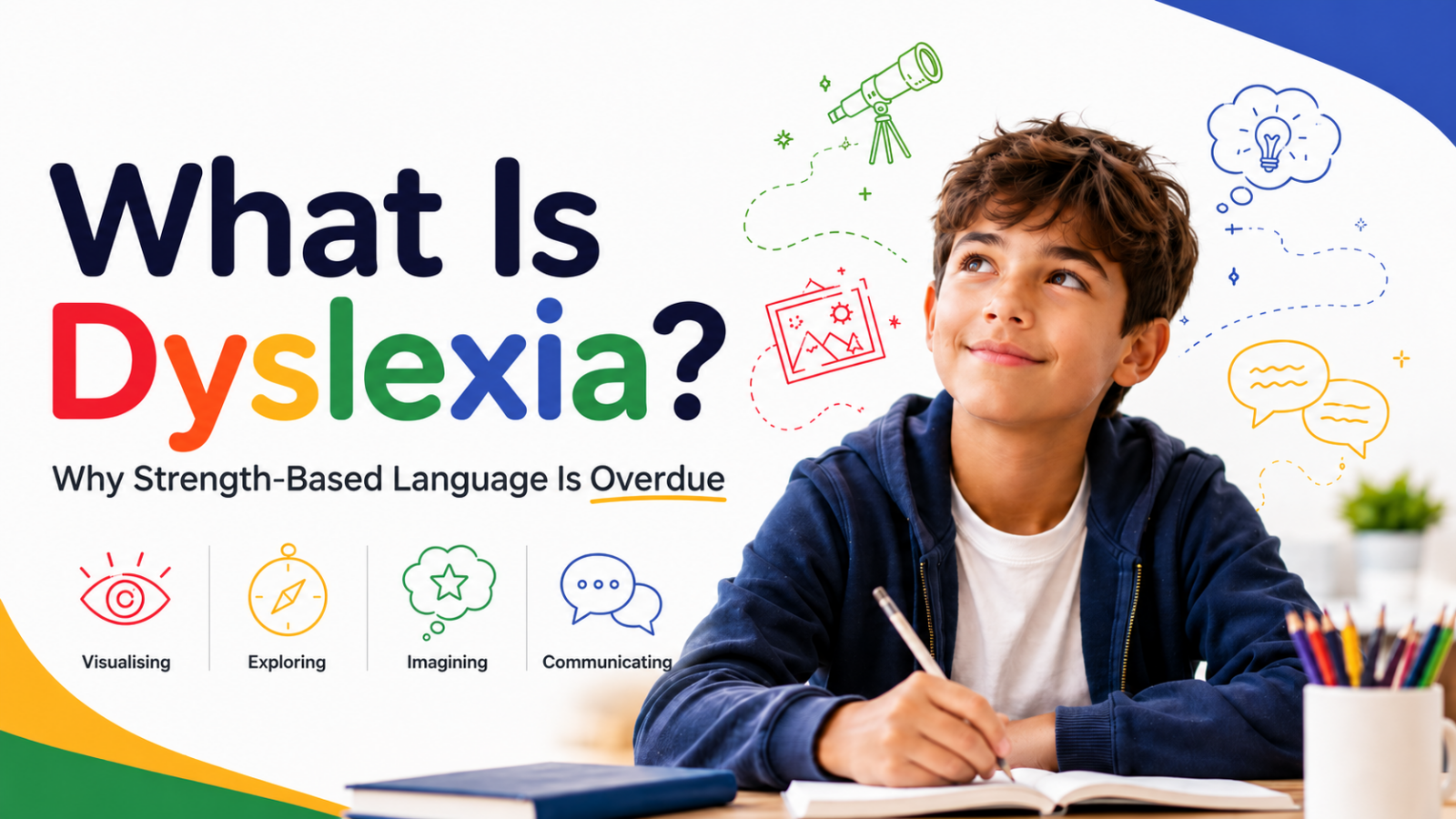
This is not merely a feel-good rebrand; it is a scientifically backed strengths profile. Adults and children with dyslexia consistently demonstrate remarkable capabilities in the following areas:
-
Visualising: The ability to interact with space, senses, and physical concepts. They can mentally manipulate 3D models and conceptualise structures with ease.
-
Exploring: An innate curiosity and the ability to explore ideas energetically, often seeing connections between disparate concepts that linear thinkers miss.
-
Imagining: Giving ideas a new spin and creating highly original work, unconstrained by traditional frameworks.
-
Communicating: Crafting and conveying clear, highly engaging messages, often excelling in oral communication and storytelling.
Intelligence 5.0 and the UK SEND Framework
The urgency to overhaul how we teach, assess, and support dyslexic children in the UK is heavily compounded by the rapid advancement of Artificial Intelligence. We are currently entering the Fifth Industrial Revolution, or “Intelligence 5.0″—an era where human minds and intelligent machines will work seamlessly side-by-side.
The skills historically prioritised by standardised testing are precisely the skills that AI can now automate. Routine data processing, basic coding, fact-recall, and standardised writing can now be generated by machines in a matter of seconds. In this new AI-powered world, human skills—specifically lateral thinking, complex problem-solving, and robust interpersonal skills—are the most sought-after assets across every global sector. The irony is stark: by judging children strictly on written exams, schools penalise the students who possess the exact neurocognitive architecture that the future demands.
Within the UK, Special Educational Needs and Disabilities (SEND) guidelines are beginning to recognise this reality. Progressive educational policies advocate for a move away from waiting for a formal “label” to access support, pushing instead for early intervention and quality-first teaching in the mainstream classroom. However, the system is still heavily reliant on a deficit model—Individualised Education Programmes (IEPs) and SEND registers typically document what a child struggles with, rather than establishing a holistic map of their capabilities. This approach can lead to systemic bottlenecks, long diagnostic waiting lists, and a failure to cultivate the child’s actual potential.
What This Means for E.L.A.H.A: Empowering the Next Generation
This critical gap between outdated educational structures and the demands of the modern world is exactly where E.L.A.H.A step in. Platforms like E.L.A.H.A are uniquely positioned to facilitate this much-needed paradigm shift across the UK education sector.
The transition from a deficit-focused educational system to a neuro-affirming one requires robust, intelligent infrastructure. E.L.A.H.A provides the comprehensive digital tools necessary to bridge the communication gap between schools, parents, students, and external SEND services.
For Schools, Headteachers, and SENCOs
The days of tracking only what a child cannot do are over. E.L.A.H.A provides educators with advanced, neuro-affirming dashboards that allow schools to track a student’s learning progress and strengths-based indicators in real-time. By documenting a child’s proficiency in “Visualising,” “Exploring,” and “Communicating” just as rigorously as their spelling scores, SENCOs can create a truly holistic view of the learner. This allows teachers to implement targeted, strength-based classroom strategies before a child experiences the profound anxiety and frustration associated with academic friction.
For Parents and Carers
Navigating the UK SEND system can be a daunting, isolating experience for families. E.L.A.H.A empowers parents by providing them with a transparent, evidence-based platform. By having access to a consistent, longitudinal record of their child’s learning patterns, adjustments, and interventions, parents are equipped with the vocabulary and the data to advocate effectively for their child. It transforms the parent-school relationship from one of reactive problem-solving to proactive collaboration.
For Students
Perhaps most importantly, E.L.A.H.A shifts the narrative for the learners themselves. By interacting with a platform that actively measures and celebrates their divergent thinking and creative problem-solving, students are protected from the negative psychological impacts of the deficit model. They learn to understand their dyslexia not as a disorder, but as a distinct cognitive advantage, fostering essential self-advocacy skills that will serve them throughout their higher education and professional lives.
For Educational Psychologists and SEN Services
E.L.A.H.A acts as a vital conduit between the classroom and external professionals. When a formal assessment is required, professionals are no longer starting from scratch. They have access to a rich, contextualised history of the student’s educational journey, detailing which interventions were successful and highlighting the compensatory mechanisms the student already employs.
Important Note: E.L.A.H.A does not diagnose dyslexia or replace professional clinical assessment; rather, it provides the essential digital tools to document learning patterns, support strategies, and evidence that helps adults make better, faster decisions.
A Call to Action for the UK Education Sector
Ultimately, the rebranding of neurodiversity isn’t just about making children feel better; it is about correcting a fundamental error in how society measures intelligence. We can no longer afford to leave a vast percentage of our dyslexic thinkers unidentified, frustrated, and unfulfilled in our classrooms, especially while the modern workforce desperately seeks their unique capabilities.
The framework for success is clear. With the integration of AI handling linear, administrative tasks, the future belongs to the creative, the empathetic, and the divergent thinkers. It is time for the UK education sector to stop asking how to “fix” dyslexic students and start asking how we can finally empower the dyslexic thinking that the world so desperately needs.
Platforms like E.L.A.H.A are building the digital foundation for this empowering new reality by providing an operational framework that values holistic intelligence, E.L.A.H.A ensures that every dyslexic learner, parent, and educator has the support they need to thrive. Together, we can guarantee that every neurodivergent mind is finally seen, supported, and celebrated for the extraordinary thinker they truly are.
References
Adi, N. S., Othman, A., Kuay, H. S., & Mustafa, Q. M. (2024). A study on the psychological functioning of children with specific learning difficulties and typically developing children. BMC Psychology, 12. https://doi.org/10.1186/s40359-024-02151-4 Cited by: 16
Demb, J. B., Boynton, G. M., & Heeger, D. J. (1997). Brain activity in the visual cortex predicts individual differences in reading performance. Proceedings of the National Academy of Sciences, 94, 13363–13366. https://doi.org/10.1073/pnas.94.24.13363 Cited by: 272
Kearns, D. M., Hancock, R., Hoeft, F., Pugh, K. R., & Frost, S. J. (2019). The Neurobiology of Dyslexia. TEACHING Exceptional Children, 51, 175–188. https://doi.org/10.1177/0040059918820051 Cited by: 196
Richards, T. L., & Berninger, V. W. (2008). Abnormal fMRI connectivity in children with dyslexia during a phoneme task: Before but not after treatment. Journal of Neurolinguistics, 21, 294–304. https://doi.org/10.1016/j.jneuroling.2007.07.002 Cited by: 213