

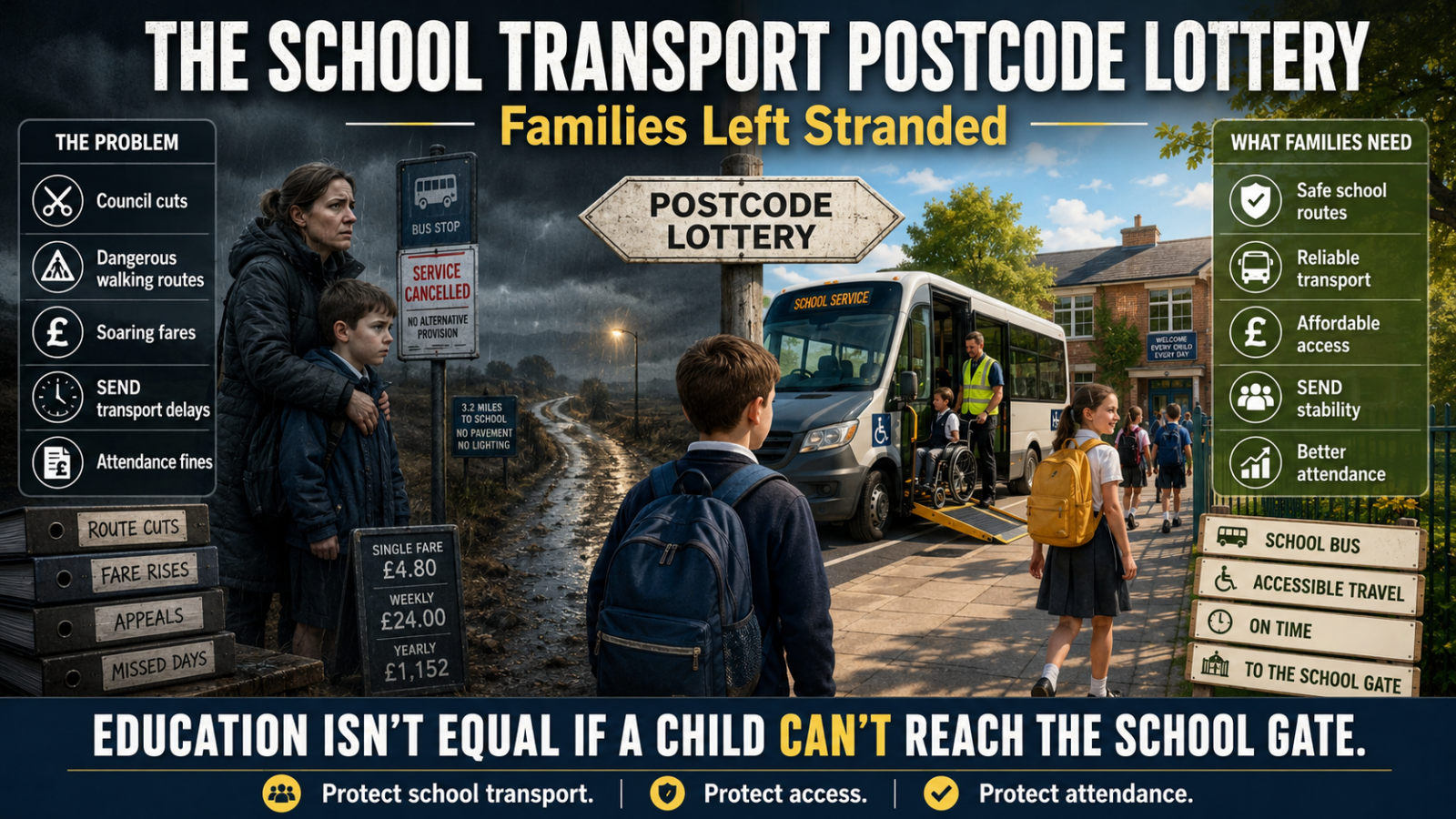
Every weekday morning across England, an invisible barrier determines whether thousands of children can safely, reliably, and equitably access their education. In one town, a student steps onto a fully subsidised, local authority-funded school bus that delivers them directly to their school gates. Just three miles away – separated only by an arbitrary municipal boundary – another student from an identical socio-economic background faces a chaotic two-hour journey involving multiple commercial buses, a dangerous walk along unlit rural roads, or total structural exclusion because their family cannot afford soaring transport fares.
This is the reality of The School Transport Postcode Lottery. While statutory frameworks exist on paper to protect basic access to education, a devastating combination of central government austerity, hyper-localised council deficits, and the aggressive deregulation of public transport has transformed school travel from a universal public service into a fragmented, exclusionary crisis.
At E.L.A.H.A., our investigative work seeks to expose the structural inequities hollowing out state education. Just as we analysed the hollowing out of experiential learning in The Death of the School Trip, the hidden diversion of targeted disadvantage funding in The Pupil Premium Gap, and the shrinking spaces for pediatric development in Playtime Squeeze, we must now confront the physical logistics of school access. Evaluating the core evidence within the file “The School Transport Postcode Lottery: Families Left Stranded” reveals a systemic failure that is actively harming the poorest families, driving chronic school absenteeism, and trapping neurodivergent and vulnerable learners on the wrong side of an institutional divide.
1. The Statutory Framework vs. Local Authority Insolvency
Under the Education Act 1996, local authorities in England hold a statutory duty to provide free school transport for “eligible children.” On paper, this baseline safety net appears comprehensive:
+--------------------------------------------------------------------------+
|                     STATUTORY ELIGIBILITY CRITERIA (THEORY)              |
+--------------------------------------------------------------------------+
|  - Children under 8 living more than 2 miles from their nearest school   |
|  - Children aged 8 to 16 living more than 3 miles from their nearest school|
|  - Children unable to walk to school due to SEND or mobility difficulties|
|  - Disadvantaged children (FSM/Universal Credit) with expanded bounds   |
+--------------------------------------------------------------------------+
The Section 114 Crisis and Discretionary Cuts
However, this statutory framework is fundamentally collapsing under the weight of local government insolvency. Over the past several years, a cascading wave of local authorities across England have issued or hovered on the brink of Section 114 notices – effectively declaring bankruptcy.
When a council goes bankrupt, it is legally mandated to protect absolute baseline statutory services while aggressively dismantling all “discretionary” spending. In the realm of school transport, this has led to a ruthless tightening of definitions and the elimination of non-statutory protections:
-
The Discretionary Cull: Post-16 transport, travel support to faith schools, and assistance for low-income families who live just under the arbitrary 2 or 3-mile distance thresholds have been systematically abolished by cash-strapped councils.
-
The “Available Route” Loophole: To escape their statutory duties, councils are increasingly reclassifying dangerous, unlit rural lanes, highway verges, and isolated tracks as “available walking routes.” Families are told that because a physical path technically exists, their child is no longer eligible for transport – ignoring real-world conditions like winter darkness, severe weather, and traffic speeds.
2. The Commercial Transport Collapse and the Poverty Penalty
For the hundreds of thousands of children who do not qualify for strict statutory council transport, accessing education relies entirely on the commercial public transport network. Here, the postcode lottery hits low-income families with brutal financial precision.
The Deregulation Trap
Outside of London—where transport remains regulated and capped under Transport for London (TfL) – bus services across England are dominated by private operators driven entirely by commercial profitability. Over the last decade, and accelerated by post-pandemic shifting patterns, private operators have cancelled thousands of unprofitable local routes, particularly in rural and semi-urban areas.
+-----------------------------------------------------------------------------+
|                     THE COMMERCIAL TRANSPORT TOLL                           |
+-----------------------------------------------------------------------------+
|  REGULATED LONDON (TfL Model):      |  DEREGULATED PROVINCES (The Reality): |
|  - Free travel for all under-16s    |  - Families pay full commercial fares |
|    on buses.                        |    per child, per term.               |
|  - Unified, protected routes        |  - Unprofitable school-run routes     |
|    prioritizing school access.      |    arbitrarily cut by private firms.  |
|  - High reliability, capped costs   |  - Cancellations force choice between |
|    insulated from market forces.    |    financial stress or attendance drops.|
+-----------------------------------------------------------------------------+
The Financial Strain on Families
Where school-specific or commercial public buses still operate, the cost has become a massive financial burden. In 2026, with the expiration or scaling back of temporary national fare caps, families outside London face exorbitant bus pass rates. For a low-income family with two or three children attending a secondary school outside their immediate walking radius, school transport costs can swallow a significant percentage of their monthly disposable income.
This functions as a literal poverty penalty. Parents are forced into impossible daily calculations: sacrificing food and utility payments to afford school bus passes, or keeping their children at home and facing punitive fines for non-attendance.
3. The SEND Transport Crisis: Starving Budgets, Stranded Children
The most acute, heartbreaking dimension of the school transport postcode lottery involves children with Special Educational Needs and Disabilities (SEND). Under the law, councils are obligated to provide free transport to school for children who cannot reasonably be expected to walk due to their SEND, regardless of distance.
Yet, because the overall SEND system in England is gripped by a profound funding crisis, home-to-school transport has become a primary target for aggressive cost-containment measures by local authorities.
The Trauma of Transport Retendering
In a desperate bid to reduce expenditure, councils are systematically retendering transport contracts to the lowest-bidding private taxi or minibus firms. For an autistic child or a student with complex learning difficulties, consistency is a fundamental prerequisite for emotional regulation. The sudden, unannounced changes that result from these cheap contracts are deeply disruptive:
-
Constant Rotations: Children face weekly changes in drivers, passenger assistants, and vehicle types.
-
Extended Travel Times: To maximise efficiency, councils are routing multiple children into single vehicles, forcing vulnerable students into chaotic, stressful multi-mile journeys lasting over 90 minutes each way.
-
Delayed Allocations: Thousands of SEND families report arriving at the start of the September academic term with no transport allocated whatsoever, forcing parents to take unpaid leave from work or watch their children miss the vital first weeks of the school year.
By reducing SEND transport to a logistical optimisation problem, councils are triggering severe sensory overload and school-induced anxiety before vulnerable children even cross the school threshold.
4. The Compounding Crisis of School Absenteeism
The government and regulatory bodies like Ofsted frequently lecture schools and parents on the absolute necessity of high attendance, utilising rigid metrics and punitive fines to combat chronic absenteeism. Yet, policymakers persistently fail to acknowledge that the school transport crisis is a direct, primary driver of the national attendance emergency.
When a localised bus route is axed by a private provider, or when a council revokes a student’s travel pass due to a budget cut, the impact on attendance is immediate. Children do not stop going to school because their families do not value education; they stop going because the physical infrastructure required to get them there has been dismantled.
This creates an incredibly punitive cycle:
-
Transport is cut: A low-income family cannot afford alternative commercial travel or lacks a private car.
-
Attendance plummets: The child is flagged by automated tracking software as “chronically absent.”
-
Punishment is issued: The parents are issued thousands of pounds in local authority attendance fines, compounding the exact financial precarity that caused the absence in the first place.
This represents the ultimate hypocrisy of the educational panopticon: the state punishes citizens for a structural failure that the state itself orchestrated through disinvestment and deregulation.
5. Reclaiming the Right to Safe Passage: A Path Forward
To resolve the school transport postcode lottery and ensure that physical access is never a barrier to educational attainment, we must move away from marketised logistics and return to school travel as a protected, public service.
We call for immediate, structural interventions across the transport and educational sectors:
1. National Standardisation and Distance Equality
The historic statutory distance thresholds (2 and 3 miles) established over half a century ago must be radically modernised. The government must establish a universal, national entitlement: free school transport for any child living more than 1.5 miles from their school, entirely insulated from localised council budgets or bankruptcy procedures.
2. Universal Regulation of School Routes
The Department for Transport, in coordination with the Department for Education, must mandate that all local authorities have the legal and financial powers to regulate and dictate bus routes servicing educational institutions. School-run transport must be designated as a protected public utility that private commercial operators cannot unilaterally cancel or exploit for profit.
3. Ringfenced SEND Transport Capital
Home-to-school transport budgets for SEND students must be permanently decoupled from general local authority funding blocks. Funding must be ringfenced and augmented by central government grants to guarantee long-term contract stability, rigorous trauma-informed training for transport staff, and strict caps on maximum commute times for neurodivergent learners.
4. Direct Reallocation of Administrative Capital
As outlined across our research catalogue, educational capital must be redirected away from expensive digital surveillance tools, behavioural tracking software, and bureaucratic data-entry interfaces. This capital must be reinvested into real-world, physical infrastructure – including school-owned minibus fleets and contracted community drivers – to ensure that every child can physically access their learning environment.
Conclusion: Free Passages to Equal Futures
Education cannot be equal if the road to the school gates is restricted by wealth and geography. The hollowing out of school transport is a stark reminder that when public services are left to the mercy of market forces and local authority austerity, it is always the most vulnerable children who are left stranded on the curb.
At E.L.A.H.A., we believe that a child’s educational journey begins the moment they step out of their front door. It is time to abolish the school transport postcode lottery, dismantle the punitive frameworks that blame parents for structural failures, and rebuild a safe, reliable, and entirely free network of public transit for every child in the nation. Let us pave a smooth, equitable path forward for the next generation.
To access our full investigative research archive, download community advocacy toolkits for local transport campaigns, and join our collaborative educational network, explore our main platform directly at E.L.A.H.A.
References & Sources
External Empirical Evidence & Public Records
1. Local Government Insolvency & School Transport Cuts
-
House of Commons Library. (2024). School transport suffers under Section 114 local government budget constraints. UK Parliament Research Briefings
-
Local Government Association (LGA). (2025). The rising, unsustainable cost of home-to-school transport for local authorities. LGA Media Hub
-
County Councils Network (CCN). (2025). Driven to bankruptcy: How discretionary school transport cuts became inevitable for England’s counties. CCN Reports
2. Bus Deregulation, Routes, & Fares
-
Campaign for Better Transport. (2024). The lost buses: How bus route cuts since 2010 have isolated communities and schools. Better Transport Archive
-
Department for Transport (DfE). (2025). National travel survey: School travel and young person transport trends in England. GOV.UK Official Data
3. SEND Home-to-School Transport Crises
-
Contact a Family. (2024). School transport inquiry: The systemic failure of SEND home-to-school travel arrangements. Contact Charity Whitepapers
-
Special Needs Jungle. (2025). The annual school transport battle: Why SEND families are left stranded every September. Special Needs Jungle Analysis
4. School Attendance & Punitive Frameworks
-
Department for Education (DfE). (2024). Working together to improve school attendance: Statutory guidance for local authorities and school governing bodies. GOV.UK Guidance
-
Children’s Commissioner for England. (2025). Missing pieces: The underlying structural and financial causes of chronic school absence. Children’s Commissioner Publications