
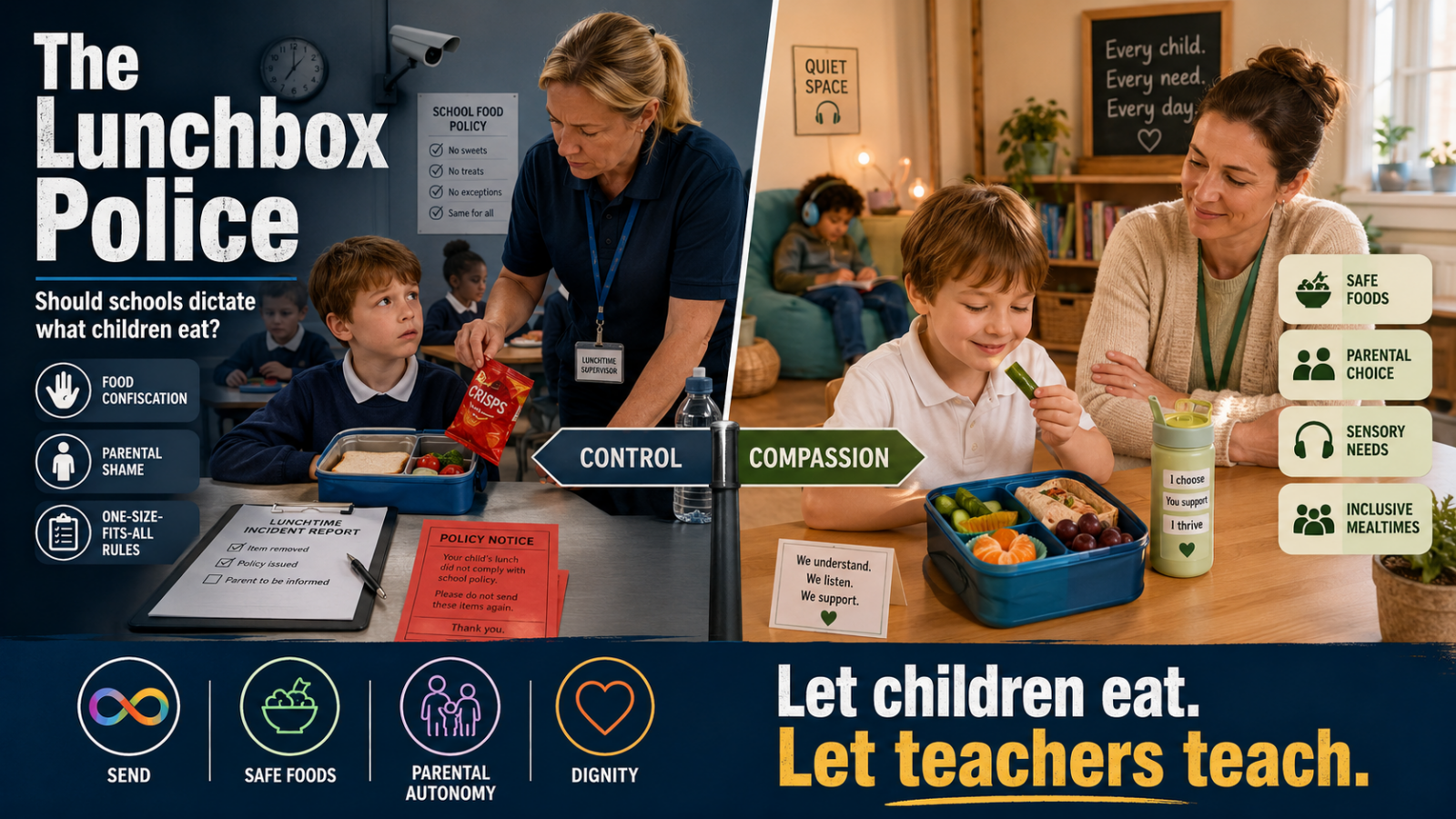
Imagine this scenario: a seven-year-old child opens their neatly packed lunchbox in a bustling school dining hall, looking forward to a small slice of homemade cake or a packet of crisps lovingly packed by their parent. Before they can take a bite, an adult stands over them, frowns, and removes the item. The child is handed a “red slip”—a formal notification of dietary failure to be brought home to their parents – or, worse yet, the food is outright confiscated, leaving the child confused, anxious, and hungry.
This is not a dystopian caricature; it is the lived reality in thousands of school dining halls across the United Kingdom and beyond. The phenomenon of the “Lunchbox Police” has evolved from an occasional overzealous school policy into a pervasive, institutional culture of surveillance and judgment.
At E.L.A.H.A., our position is uncompromising: children who bring a packed lunch to school should be allowed to eat whatever their parents have provided. Schools are institutions of learning, staffed by educators whose primary mandate is to cultivate intellectual growth, foster creativity, and build foundational knowledge. They are teachers, not parents. When schools overstep this boundary to dictate domestic choices, they create an adversarial relationship with families, ignore the complex realities of socioeconomic hardship, and – most critically – enforce guidelines that actively harm children with Special Educational Needs and Disabilities (SEND), including Autism Spectrum Disorder (ASD), ADHD, and Avoidant/Restrictive Food Intake Disorder (ARFID).
1. The Rise of the Lunchbox Surveillance State
The evolution of school food monitoring can be traced back to well-intentioned public health initiatives designed to combat childhood obesity and improve pediatric nutrition. In the UK, the legacy of Jamie Oliver’s 2005 school dinner crusade and the subsequent implementation of the government’s School Food Plan shifted the focus heavily onto what children consume during school hours. While these policies successfully established nutritional guidelines for school-provided meals, they triggered a secondary, unmandated phenomenon: the intense, hyper-regulated policing of home-packed lunches.
This institutional overreach is well-documented in the public sphere:
-
The Media Reality: A prominent BBC News report highlighting schools in the Humber region revealed the extent of this surveillance, detailing cases where primary schools implemented draconian lunchbox bans on everyday items like sausage rolls, meat pies, and flavoured waters, sparking massive public backlash from parents who felt targeted and undermined.
-
The Parental Outcry: Digital parenting communities, such as Netmums, feature endless, emotionally charged “rants” from mothers and fathers who describe the deep embarrassment, parental guilt, and anger caused by school staff inspecting their children’s lunches and confiscating food.
-
The Nutritional Critique: Experts like The Curious Nutritionist have long warned that when teachers act as the lunchbox police, it fundamentally damages a child’s psychological relationship with food, introducing unnecessary shame, anxiety, and a toxic “good vs. bad” dichotomy to eating.
The ultimate irony is that while schools intensely police the contents of home-packed containers, school-provided dinners themselves often fall short. Academic research indicates that many school canteen systems serve food that is highly institutionalised, unappealing, or heavily reliant on processed options to cut costs. According to sociological research into the School Food Plan, there is a profound disconnect between the nutritional ideals preached by policymakers and the lived social context of the school dining room. By fixating solely on what children put in their mouths rather than the social environment of eating, schools have transformed dining halls into arenas of surveillance rather than spaces of community and nourishment.
2. The SEND Crisis: Neurodivergence, Senses, and “Safe Foods”
The most damaging consequence of rigid lunchbox policing is felt by the neurodivergent community. For children with intellectual and developmental profiles such as Autism Spectrum Disorder (ASD) and ADHD, food is not merely a collection of macronutrients—it is a profound sensory minefield.
+-----------------------------------------------------------------------+
|                       THE NEURODIVERGENT MEALTIME                     |
+-----------------------------------------------------------------------+
|  [ Sensory Profile ]  --> Hyper-reactivity to textures, smells, colors|
|  [ Interoception ]    --> Difficulty identifying hunger/fullness signals|
|  [ Executive Fn. ]    --> Executive dysfunction making waiting complex |
|  [ Core Need ]        --> "Safe Foods" to maintain emotional regulation|
+-----------------------------------------------------------------------+
Sensory Processing and Interoception
Autistic and ADHD children process sensory information with extreme intensity. A specific brand of chicken nugget, a particular type of crisp, or a specific white bread sandwich may represent their only “safe foods” – items that provide predictable, uniform sensory feedback. Research exploring comfortable eating in autistic populations demonstrates that adherence to specific routines and dietary sameness serves as a vital functional strategy to navigate the overwhelming sensory chaos of the school day.
Furthermore, neurodivergent children often face challenges with interoception—the internal sensory system that allows humans to perceive internal bodily signals like hunger, fullness, or heart rate. When a school imposes strict rules banning a child’s safe foods, they do not encourage the child to eat a salad; they simply guarantee that the child will not eat at all.
The Trauma of Forced Exposure
When the “Lunchbox Police” confiscate a neurodivergent child’s safe food because it does not meet a generic, neurotypical standard of “healthiness,” the fallout is severe:
-
Sensory Meltdowns: Stripping a child of their emotional anchor in a chaotic dining hall frequently triggers profound sensory and behavioural meltdowns.
-
Extreme Hunger: A hungry child cannot learn. Depriving a neurodivergent student of their predictable source of fuel leads to low blood sugar, lack of focus, and behavioural dysregulation in afternoon classes.
-
Long-Term Eating Trauma: Oral history case studies investigating neurodivergent perspectives of the UK school meals service reveal that rigid food policing and sensory coercion in schools are directly linked to the development of lifelong selective eating disorders and deep-seated anxieties around food.
As highlighted in The Lunchbox Study published in Nutrients, children on the autism spectrum inherently exhibit more limited diets due to their clinical features. Forcing these children to adapt to arbitrary institutional rules shows a total lack of empathy and a fundamental misunderstanding of special educational needs.
“To expect an autistic child with severe sensory processing differences to eat an unfamiliar food under the threat of confiscation is not health promotion; it is institutional cruelty.”
3. Teachers vs. Parents: Realigning Institutional Boundaries
The modern school system is suffering from a massive identity crisis, continuously absorbing roles historically held by the family unit. While schools play a vital role in safeguarding and social welfare, they must remember their core identity: they are centres of education, not the arbiters of domestic life.
The Limits of Educational Authority
Parents carry the primary legal, financial, and emotional responsibility for raising their children. They understand their child’s unique history, medical eccentricities, psychological vulnerabilities, and daily preferences better than any school administrator ever could. When a teacher overrides a parent’s conscious decision regarding what to pack in a lunchbox, they undermine parental authority and disrupt the delicate ecosystem of the home.
A parent may intentionally include a high-calorie treat because their child has been ill and losing weight; they may pack a specific item as a behavioural incentive for a child struggling with severe separation anxiety; or they may simply be trying to ensure their selective eater consumes something during a gruelling seven-hour school day. The school food worker or lunchtime supervisor standing over the bin lacks the context to make that judgment call.
The Diversion of Precious Resources
Our position on this matter is deeply connected to a wider systemic critique we have pioneered at E.L.A.H.A. In our extensive analysis, “The Death of the School Trip: How Funding Cuts Cost Cultural Capital,” we detailed how severe financial deficits across the UK educational landscape have forced schools to scale back on baseline cultural enrichment, field trips, and essential learning resources.
There is an intellectual contradiction here that cannot be ignored:
+--------------------------------------------------------------------------+
|                     THE INSTITUTIONAL CONTRADICTION                      |
+--------------------------------------------------------------------------+
|  WHAT SCHOOLS CLAIMS TO LACK:     |   WHAT SCHOOLS AGGRESSIVELY FUND:    |
|  - Budgets for Field Trips        |   - Staff Hours for Lunch Inspections|
|  - Funding for Creative Arts      |   - Systems for Dietary "Red Slips"  |
|  - Adequate SEND Support Staff    |   - Surveillance of Family Choices   |
+--------------------------------------------------------------------------+
If schools genuinely lack the funding to provide basic cultural capital and experiential learning outside the classroom, how can they justify spending precious staff hours, energy, and emotional capital acting as dietary border guards? The role of the teacher is to teach Shakespeare, mathematics, science, and history. It is not to audit the fat content of a child’s lunchtime dairy intake. Schools must redirect their focus back to their core educational mission, leaving the management of home-cooked or home-packed nutrition strictly to the domestic sphere.
4. The Socioeconomic Reality and Parental Shaming
Lunchbox policing does not occur in a vacuum; it heavily penalises families from lower socioeconomic backgrounds, exacerbating the stressors of an ongoing cost-of-living crisis. Mixed-methods research into parent lunchbox decision-making reveals that food selection is an incredibly complex, emotionally charged task influenced by financial constraints, time availability, and accessibility.
The Financial Strain of “Healthy Eating”
The public health discourse surrounding what constitutes a “perfect” lunchbox is often deeply classist, operating under the assumption that every family has the disposable income, time, and kitchen resources to prepare fresh, organic, whole-food meals every morning. For a working-class parent holding down multiple jobs, store-bought, pre-packaged “ready-to-go” snacks are affordable, time-efficient, and shelf-stable.
When schools ban processed snacks or pre-packaged convenience items, they place a severe financial and logistical burden on parents. If a parent cannot afford the fresh berries or specific artisanal items deemed acceptable by a school’s rigid policy, they are left with a harrowing choice: spend money they do not have, or send their child to school with a sense of impending shame.
The Dynamics of Shame
The implementation of lunchbox inspections introduces a toxic social dynamic into the dining hall:
-
The Judgment of the Bin: Children quickly learn to look at their peers’ lunchboxes through the lens of institutional approval. A child whose lunch is flagged or confiscated becomes an immediate target for social exclusion or bullying.
-
Parental Alienation: Rather than encouraging parents to partner with schools, the “Lunchbox Police” foster a culture of resentment and alienation. Parents who feel constantly monitored and judged by their child’s teachers are far less likely to engage in parent-teacher evenings, school communities, or collaborate effectively on crucial educational goals.
5. A Compassionate, Inclusive Framework for School Mealtimes
Rejecting the authoritarian structure of lunchbox policing does not mean we must abandon the pursuit of child wellness. Instead, we must replace coercion with compassion and surveillance with genuine inclusivity.
Schools can foster healthy, happy eating environments without policing a single lunchbox:
1. Universal Exemptions for SEND and Selective Eaters
Schools must establish a foundational policy that completely exempts children with identified special educational needs, disabilities, or documented selective eating patterns from generic food restrictions. A child’s safe foods must be protected as a matter of basic educational accessibility and emotional safeguarding.
2. Autonomy in the Dining Environment
Instead of policing what goes into a child’s mouth, schools should focus on improving the chaotic, noisy, and high-stress environment of the dining room itself. Reducing queue times, creating quieter, sensory-friendly eating spaces, and allowing children to sit comfortably with their peers will do infinitely more to improve nutritional intake and emotional regulation than any lunchbox ban.
3. Food Education Over Food Inspection
True nutrition literacy is cultivated in the classroom through cooking, gardening, and positive exposure, not through the shaming ritual of food confiscation. As pediatric feeding specialists note, children learn to naturally expand their diets when they are given control, autonomy, and low-pressure exposure to new foods over time.
Conclusion: Let Children Eat, Let Teachers Teach
The dining hall should be a place of respite, joy, and community – a necessary pause in a demanding academic day. By converting this space into a regulatory checkpoint, the “Lunchbox Police” have compromised child welfare, alienated parents, and added an unnecessary layer of anxiety to the educational experience.
At E.L.A.H.A., we call for an immediate end to the surveillance of home-packed lunches. We must allow parents to be parents, trusting them to navigate the nutritional, financial, and emotional needs of their children. Let us ensure that our schools focus their precious, depleted resources on reclaiming the rich cultural capital of education. A well-fed child, secure in their bodily autonomy and free from the threat of institutional shame, is a child who is truly ready to learn.
References & Sources
-
Boyd, W. (n.d.). A journey into school lunchbox decision-making: A mixed-methods exploration of Australian parents. PMC.
-
Cited by: 1
-
-
Carter, I. (2025). Control, resistance, and the senses: Neurodivergent perspectives of the UK school meals service; A case study. Taylor & Francis.
-
Cited by: 1
-
-
Dimbleby, H. (n.d.). The School Food Plan. GOV.UK.
-
Cited by: 172
-
-
Hart, C. S. (2016). The School Food Plan and the social context of food in schools. Cambridge Journal of Education, 46(2), 211-231. https://doi.org/10.1080/0305764x.2016.1158783
-
Cited by: 65
-
-
Lawrence, C. (2025). ‘If we are what we eat, where does that leave us?’ Exploring comfortable eating with autistic people. GuildHE Repository.
-
Manson, A. C., Golley, R. K., & Johnson, B. J. (2025). Global parent perspectives on school food service internationally: A mixed papers narrative review. Nutrition & Dietetics. https://doi.org/10.1111/1747-0080.12926
-
Cited by: 8
-
-
Padmanabhan, P. S., & Shroff, H. (2020). Addressing mealtime behaviours of children with autism spectrum disorders in schools: A qualitative study with educators in Mumbai, India. International Journal of Developmental Disabilities, 68(3), 198-206. https://doi.org/10.1080/20473869.2020.1738794
-
Cited by: 12
-
-
Potock, M. (2016). A food adventure for picky eaters: Packing their own lunches. The ASHA Leader.
-
Seiverling, L., Felber, J., Howard, M., Williams, K., & Hendy, H. M. (2022). The Lunchbox Study: A pilot examination of packed lunches of children with autism spectrum disorder. Nutrients, 14(7), 1338. https://doi.org/10.3390/nu14071338
-
Cited by: 3
-
Additional Contextual & Digital Resources
-
BBC News. (2014). Parents hit back at the primary school lunchbox policy. Retrieved from
[https://www.bbc.co.uk/news/uk-england-humber-29422370](https://www.bbc.co.uk/news/uk-england-humber-29422370) -
Netmums. (2014). Coffeehouse forum: Rant about lunch box police. Retrieved from
[https://www.netmums.com/coffeehouse/family-food-recipes-555/feeding-kids-481/1006359-rant-about-lunch-box-police.html](https://www.netmums.com/coffeehouse/family-food-recipes-555/feeding-kids-481/1006359-rant-about-lunch-box-police.html) -
E.L.A.H.A. (2024). The death of the school trip: How funding cuts cost cultural capital. Retrieved from
[https://www.elaha.uk/the-death-of-the-school-trip-how-funding-cuts-cost-cultural-capital/](https://www.elaha.uk/the-death-of-the-school-trip-how-funding-cuts-cost-cultural-capital/) -
The Curious Nutritionist. (2020). When your child’s teacher is the lunchbox police. Retrieved from
[https://thecuriousnutritionist.com.au/childs-teacher-is-the-lunch-box-police/](https://thecuriousnutritionist.com.au/childs-teacher-is-the-lunch-box-police/)