

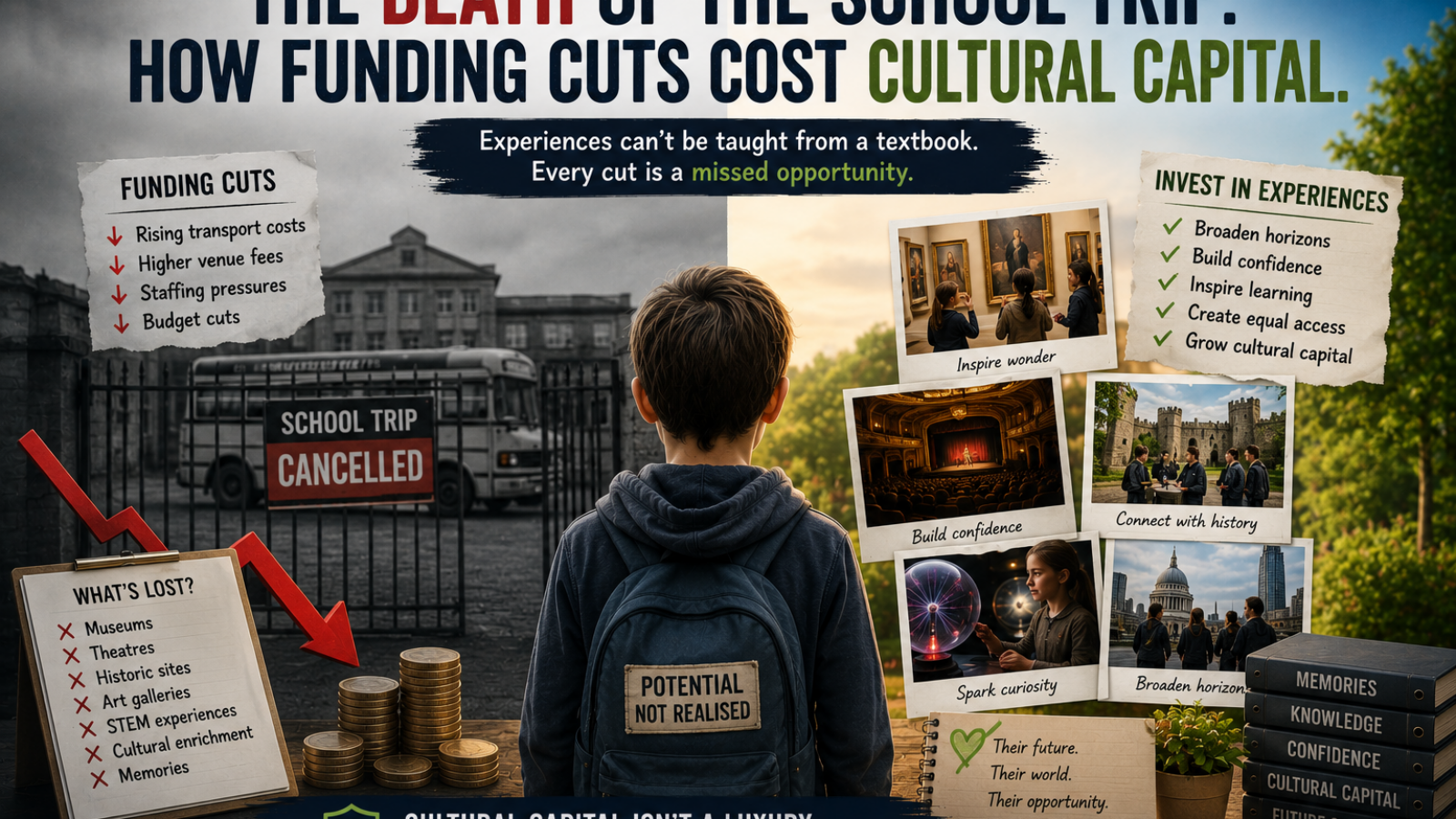
There was a time when the school trip was a rite of passage – the excitement of the coach journey, the hands-on discovery of a museum, the first taste of independence. For generations of students, these excursions served as the vibrant punctuation marks of the academic year, transforming abstract textbook concepts into tangible, breathing reality. Today, that pillar of educational life is fading. Across the United Kingdom, an unprecedented convergence of economic pressures, administrative bottlenecks, and shifting institutional priorities is actively eroding the foundation of experiential learning. Chronic funding cuts have forced many schools to scrap these essential experiences, leading to a profound decline in the ‘cultural capital‘ – the real-world experiences and knowledge – that disadvantaged students are able to access.
As educational institutions navigate a sustained cost-of-living crisis, the structural integrity of the extracurricular landscape is quietly collapsing. What was once viewed as an unquestionable necessity for a well-rounded education is increasingly categorised as a disposable luxury. However, framing the school trip as a mere “bonus” fundamentally misunderstands the sociology of learning and the mechanics of social mobility. When the school trip dies, we do not merely lose a day out; we lose a critical engine of equity, leaving the most vulnerable students anchored to their immediate geographical and socioeconomic realities.
The Sociological Imperative of Cultural Capital
To comprehend the true magnitude of this loss, one must first deconstruct the concept of “cultural capital.” Originally coined by sociologist Pierre Bourdieu, cultural capital refers to the accumulation of knowledge, behaviours, and skills that a student can draw upon to demonstrate cultural competence and, thus, social status. It is the unspoken currency of society. It dictates how confidently a young person can navigate a university interview, analyse a piece of classic literature, or converse in a professional corporate environment.
Education is not just about the curriculum delivered within the four walls of a classroom. It is about broadening horizons, fostering curiosity, and making learning tangible. When a child visits a contemporary art gallery, stands in the shadow of a medieval cathedral, or conducts field research on a coastal shoreline, they are not simply acquiring facts; they are building an internal reservoir of contextual references. They are learning that these spaces – institutions of power, history, and culture – belong to them just as much as anyone else.
For affluent students, the erosion of the school trip is a disappointment, but rarely a developmental catastrophe. Middle-class and wealthy families possess the disposable income to independently subsidise this cultural enrichment. They visit museums on weekends, travel internationally during half-terms, and enrol in private music and drama academies. However, for a rapidly growing demographic of children living in poverty, the school is the sole provider of these experiences. When trips are cut, it is the students who cannot afford the ‘private’ version of these experiences (museum visits with family, extracurricular clubs, travel) who lose the most. The playing field, already steeply tilted, becomes entirely insurmountable. The curriculum becomes a dry, two-dimensional exercise, stripped of the awe and wonder necessary to cement long-term academic engagement.
The Statistical Reality: A Landscape of Financial Attrition
The decline of the school trip is not a theoretical warning; it is a measurable, statistical reality unfolding across the British educational sector in 2026. The financial pressures bearing down on multi-academy trusts (MATs) and local authority-maintained schools are severe. Rising energy bills, increased staff wage bills without corresponding central government funding, and the general inflation of educational supplies have decimated discretionary budgets.
Recent national data from educational research bodies such as the Sutton Trust paint a grim operational picture. In recent polling, up to 50% of senior school leaders reported having to cut school trips and outings due to financial constraints – a figure that has more than doubled in a remarkably short timeframe. Crucially, the data reveal a devastating geographical and socioeconomic divide. Schools serving the most disadvantaged communities are significantly more likely to Axe these experiences compared to schools in affluent areas. When a school’s Pupil Premium funding is being desperately diverted to plug core budget deficits or retain basic teaching assistants, funding a coach to a local nature reserve suddenly becomes an impossible mathematical equation.
Furthermore, the logistical costs associated with external visits have skyrocketed. Transport costs alone have become prohibitive, with private coach hire rates surging. Venues that historically offered heavily subsidised or free access for state schools have been forced to introduce entry fees to survive their own funding crises. The result is a system where the “cost per head” of a basic day trip frequently exceeds what low-income parents can legally be asked to contribute, and what schools can ethically afford to subsidise.
The Hidden Cost of ‘Core Only’ Education
The response to this financial squeeze is often a strategic retreat to a “core only” educational model. Schools, terrified of slipping Ofsted grades and desperate to maintain baseline literacy and numeracy statistics, strip away the periphery to protect the centre. This approach, while administratively understandable, carries a devastating hidden cost.
The Psychological and Emotional Toll
Beyond academic context, school trips serve as vital catalysts for emotional regulation, peer bonding, and psychological well-being. Behavioural scientists and modern pedagogical studies consistently demonstrate that moving learning beyond the classroom yields massive spikes in pupil curiosity, excitement, and overall happiness. For neurodivergent learners, or students who struggle with the rigid behavioural expectations of a traditional classroom, an outdoor educational visit often provides a crucial opportunity to excel and demonstrate leadership in a dynamic environment. Stripping these opportunities away contributes directly to the current crisis in student mental health and persistent school refusal.
The Erosion of Aspirational Horizons
An education confined entirely to the classroom breeds a localised, insular mindset. If a student has never left their post-industrial town or inner-city borough, their concept of what is possible in their future is artificially restricted. They cannot aspire to work in sectors or environments they do not know exist. Experiential learning breaks these invisible geographic and psychological boundaries, offering a vital glimpse into wider societal possibilities.
The Attrition of Practical Application
Subjects such as Geography, Biology, and History rely heavily on the transition from theory to practice. Reading about coastal erosion in a textbook is a fundamentally different cognitive exercise than standing on a beach measuring longshore drift. When a “core only” approach dictates that all learning must be theoretical, schools inadvertently disadvantage their students in rigorous GCSE and A-Level examinations, which increasingly demand applied knowledge and evaluative reasoning based on real-world case studies.
The Administrative Paralysis: The Unseen Workload
While financial constraints are the primary driver of the school trip’s demise, they are deeply compounded by an equally destructive force: administrative paralysis. The modern educational landscape is characterised by high-stakes accountability and a risk-averse culture. Over the past decade, the bureaucratic burden required to plan, authorise, and execute even a minor off-site visit has expanded exponentially.
Teachers, already buckling under unmanageable workloads, are frequently expected to sacrifice hours of their personal time to navigate a labyrinth of red tape. The process typically involves:
- Drafting exhaustive, multi-page risk assessments covering every conceivable hazard.
- Securing complex internal approvals across multiple layers of senior leadership.
- Managing arduous parental communication, consent forms, and dietary requirement tracking via fragmented IT systems.
- Navigating the post-Brexit administrative friction required for international travel, including complex visa and passport regulations for varied student cohorts.
- Coordinating complex staffing cover to ensure the rest of the school continues to function in their absence.
Recent surveys of teaching professionals in 2026 suggest that over half of practitioners spend upwards of 11 hours of unstructured personal time organising a single trip, with many spending more than 20 hours. Unsurprisingly, a growing number of exhausted educators are simply choosing to step back. The goodwill that historically powered the extracurricular life of a school has been systematically depleted by a system that fails to provide the operational infrastructure needed to support it.
Ensuring Equitable Access with Operational Precision
The stark reality is that sweeping central government funding increases are unlikely to materialise with the speed or scale required to save the school trip in the immediate term. Therefore, the sector must pivot from a mindset of lamentation to a strategy of rigorous operational optimisation. If we cannot restore the funding overnight, we must restore the efficiency with which we utilise what we have.
To prevent the total collapse of experiential learning, school leadership teams must abandon ad-hoc, siloed planning in favour of a cohesive, data-driven approach. Schools need to be more strategic and data-driven in how they prioritise experiential learning, ensuring that every trip – large or small – is maximised for its impact on student engagement and progress. We can no longer afford “just for fun” trips that lack a clear pedagogical or developmental return on investment. Instead, every pound spent and every hour of staff time invested must be surgically aligned with institutional goals and student welfare needs.
Deploying E.L.A.H.A: The Digital Architecture of Experiential Learning
Achieving this required level of operational precision is impossible using legacy spreadsheets, fragmented email threads, and disconnected management information systems. Schools require a unified digital architecture capable of seamlessly connecting financial planning, staff workload management, and student welfare tracking. E.L.A.H.A offers an operational framework to help leaders do exactly this.
As detailed across their comprehensive platform offerings, E.L.A.H.A acts as a singular, intelligent operational spine for modern educational institutions. By centralising the tracking of student engagement and progress, E.L.A.H.A enables schools to:
- Evidence the Impact of Experiential Learning: To protect trip budgets from the financial chopping block, school leaders must be able to prove their quantitative and qualitative value to governing bodies and multi-academy trust directors.
- Target Resources to the Most Vulnerable: The platform allows schools to use data to identify which students stand to benefit the most from extracurricular exposure, ensuring that limited resources reach those who need them most.
- Collaborate on Value and Eradicate Administrative Paralysis: The platform makes it easy for staff to share the educational goals and outcomes of trips, ensuring they aren’t just ‘time off’ but integrated, high-value components of the broader curriculum.
We stand at a critical juncture in the history of British education. If we allow the current trajectory to continue unchallenged, we will formally codify a two-tier educational system: one rich in vibrant, real-world discovery for the wealthy, and one defined by sterile, classroom-bound drudgery for the poor. The death of the school trip is a loss for all, but particularly for the most disadvantaged.
However, this decline is not inevitable. By refusing to accept administrative inefficiency and by leveraging powerful, purpose-built technological platforms to optimise resources, school leaders can fight back. By bringing operational precision to how we plan and evaluate these experiences, E.L.A.H.A helps schools protect this vital component of a well-rounded education, ensuring that horizons remain broad for every student. Through strategic determination and intelligent infrastructure, we can ensure that the school trip remains not a relic of the past, but a permanent, vital right of passage for generations to come.
References & Sources
- E.L.A.H.A Official Platform Offerings: https://www.elaha.uk/ – Information regarding the unified operational architecture for schools, including engagement tracking and resource management.