

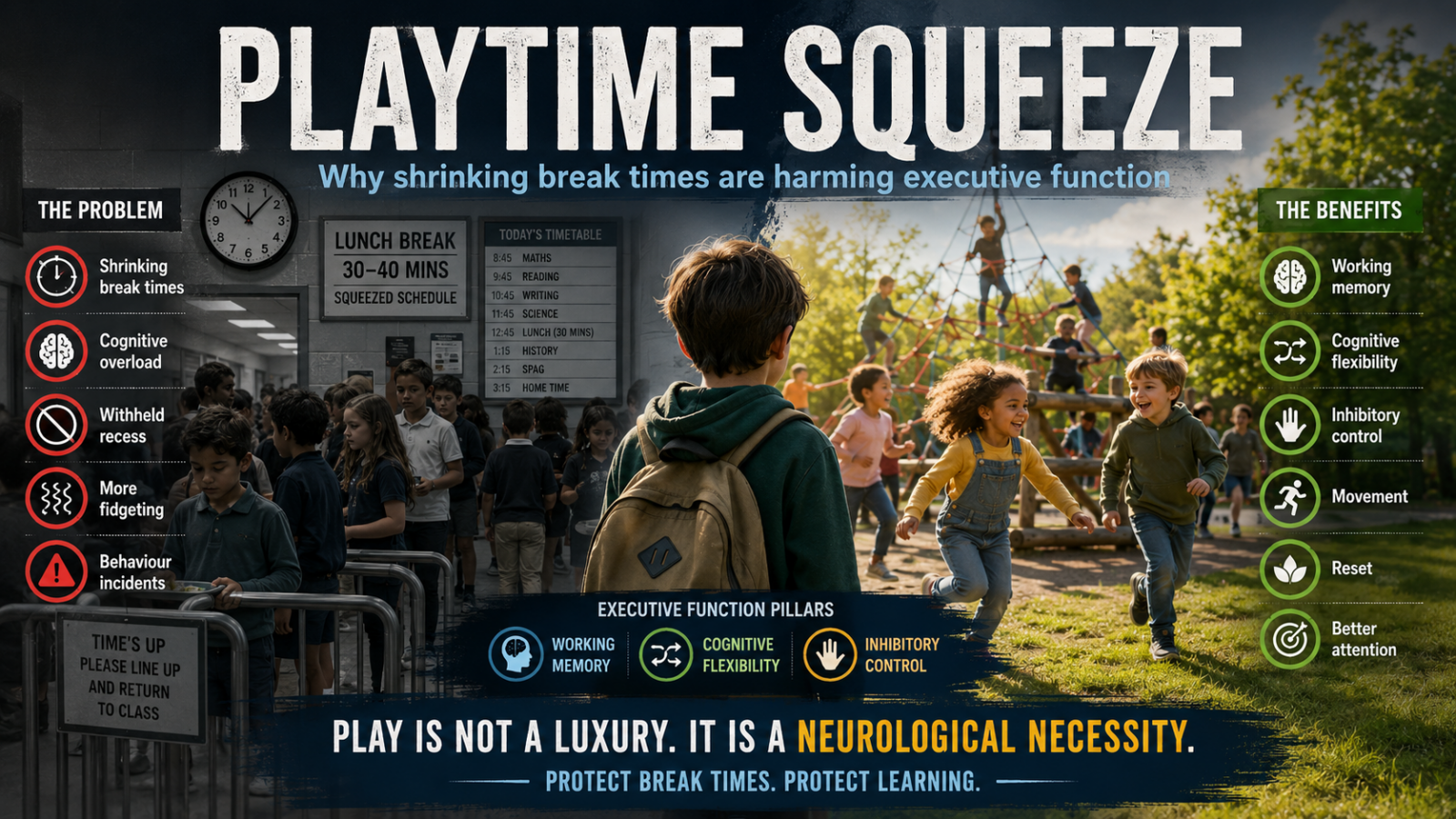
Step onto a state school campus during midday, and you might notice a subtle but profound structural shift: the traditional, raucous hour-long lunch break has vanished. In its place is a highly choreographed, hyper-compressed window – often lasting a mere 30 to 40 minutes – where children are expected to navigate crowded dining facilities, consume their food, and immediately return to their desks.
This is the reality of the “Playtime Squeeze”. Over the past three decades, school break times in the United Kingdom have been systematically eroded, stripped away minute by minute to accommodate an overcrowded curriculum, satisfy intense examination pressures, and simplify institutional behaviour management.
At E.L.A.H.A., our collaborative research has consistently focused on the holistic rights of the child. In The Lunchbox Police, we exposed the surveillance of the dining hall; in Zero-Tolerance Behaviour Policies, we exposed the criminalisation of neurodivergent movement; and in Teacher Strikes and Workload, we analysed how data-driven metrics hollow out professional autonomy.
Now, by evaluating the core arguments within the file “Playtime Squeeze Why Shrinking Break Times Are Harming Executive Function.gdoc”, we turn our attention to the physical and cognitive foundation of learning itself. Unstructured play is not an optional reward, a luxury, or a non-essential luxury; it is a neurological necessity. By squeezing playtime out of the school day, our educational system is directly compromising the development of executive function in young people, creating an environment that starves the developing brain of the exact breaks it requires to think, adapt, and learn.
1. The Anatomy of Executive Function: How the Brain Learns
To understand why shrinking break times are so damaging, we must look at the cognitive architecture of the developing human brain. Executive function refers to a suite of top-down mental processes managed primarily by the prefrontal cortex. It is the cognitive engine that allows children to pay attention, plan, organise, remember instructions, regulate emotions, and switch focus between tasks.
+———————————————————————–+
| THE THREE PILLARS OF EXECUTIVE FUNCTION |
+———————————————————————–+
| 1. WORKING MEMORY –> The ability to hold and manipulate |
| information over short intervals. |
| 2. COGNITIVE FLEXIBILITY –> The capacity to switch gears, adapt to |
| new rules, and see multiple perspectives. |
| 3. INHIBITORY CONTROL –> The power to resist impulsive actions, |
| filter distractions, and delay reward. |
+———————————————————————–+
Cognitive Load Theory and the Prefrontal Cortex
The prefrontal cortex has finite processing capacity. When children are subjected to back-to-back blocks of academic instruction without meaningful, unstructured breaks, their working memory experiences cognitive overload.
The brain requires periods of default mode network (DMN) activation – mind-wandering, physical movement, and low-stakes social interaction – to consolidate newly acquired knowledge, clear neural metabolic waste, and restore its capacity for attention. When breaks are squeezed, this restorative cycle is broken. The result is not more learning; it is a state of cognitive gridlock where information is presented but can no longer be processed or retained.
2. Documenting the Squeeze: The Shrinking School Day
The reduction of playground time is not an anecdotal observation; it is a documented, long-term institutional trend. Extensive longitudinal research conducted by the UCL Institute of Education has tracked the erosion of school break times across England for decades:
- The Quantitative Collapse: Longitudinal data demonstrate that since 1995, children across all age groups have lost substantial amounts of break time per week. For secondary school pupils, the standard lunchtime has been compressed, with many institutions cutting the total break allocation by up to 60 minutes per week.
- The Elimination of Afternoon Recess: Unstructured afternoon breaks, which were once a staple of the primary school day, have been almost completely eliminated across state schools.
- The Post-Pandemic Acceleration: In the wake of pandemic-related learning gaps, schools accelerated the compression of breaks, converting unstructured social time into mandatory academic intervention blocks, tutoring catch-ups, or rigid administrative registration periods.
The rationale provided by school administrators for this compression typically revolves around safety, behavioural management, and curriculum demands. It is easier for understaffed schools to supervise children inside a structured classroom than to police a playground. However, this short-term administrative convenience carries an immense, long-term cognitive cost for students.
3. The Interconnected Failures of the Educational Panopticon
The Playtime Squeeze does not occur in a vacuum; it sits at the exact intersection of the systemic crises we have highlighted throughout our research catalogue.
+————————————————————————–+
| THE VICIOUS CYCLE OF THE PLAYTIME SQUEEZE |
+————————————————————————–+
| [ Shrinking Breaks ] –> Accumulation of physical & sensory restlessness|
| v |
| [ Fidgeting/Movement]–> Tagged as “non-compliance” on behaviour apps |
| v |
| [ Zero-Tolerance ] –> Automated detentions / Withholding of play |
| v |
| [ Total Dysregulation]–> Severe meltdowns, burnout, and school refusal |
+————————————————————————–+
The Synergy with Zero-Tolerance Behaviour Policies
When a child’s break time is cut short, their physiological need for movement does not simply disappear. Instead, that energy is carried directly back into the classroom. Cooped-up children naturally experience higher rates of motor restlessness, tapping, fidgeting, and lapses in attention.
Under the strict behaviour frameworks we analysed in Zero-Tolerance Behaviour Policies: A Disproportionate Impact on Neurodiversity?, these physiological attempts at self-regulation are treated as willful non-compliance. A child who is fidgeting because they have been denied adequate outdoor play is flagged on tracking apps and issued a demerit, detention, or removal from the room. The school punishes the symptom of a restriction that the institution itself created.
The Connection to Teacher Strikes and Workload
The compression of break times is also deeply linked to the staffing and retention crisis we mapped in Teacher Strikes and Workload: Has EdTech Actually Delivered on Its Promises?. Because school budgets are strained, schools lack the funding to employ dedicated, trained lunchtime supervisors.
As a result, classroom teachers are routinely pulled into mandatory playground or corridor duties during their own nominal breaks. To minimise this additional workload and reduce the window for behavioural incidents that require administrative logging, management teams compress the breaks entirely. The tech-driven tracking systems make it efficient to police the day in tight, uniform blocks, but it starves both teachers and students of the essential downtime needed to avoid burnout.
Replicating the Hollowing of The Death of the School Trip
In our foundational article, “The Death of the School Trip: How Funding Cuts Cost Cultural Capital,” we detailed how real-world, experiential learning has been systematically sacrificed to fund administrative systems and data compliance. The Playtime Squeeze is driven by the same institutional mindset. Schools have prioritised performative academic metrics over the physical, experiential, and unstructured space required for healthy pediatric development.
4. The Disproportionate Toll on Neurodivergent Learners
While the contraction of playtime harms all children, its impact is catastrophic for students with Special Educational Needs and Disabilities (SEND), particularly those with Autism Spectrum Disorder (ASD), ADHD, and sensory processing differences.
Sensory Resetting and Co-Regulation
For a neurodivergent child, the sensory environment of the modern school day is intensely overwhelming. The noise of the classroom, the cognitive demands of task switching, and the effort required to mask their traits to fit neurotypical expectations drain their neurological battery rapidly.
Unstructured playtime acts as a vital pressure valve. Whether it is through intense physical movement (stimming, running) or finding a quiet corner outdoors, this time allows their nervous system to reset.
The Injustice of Withholding Recess
One of the most counterproductive practices still prevalent in state education is the withholding of break time or recess as a punishment for uncompleted classwork or behavioural infractions.
+————————————————————————–+
| THE COGNITIVE MISCONCEPTION |
+————————————————————————–+
| INSTITUTIONAL BELIEF: | NEURO-AFFIRMING REALITY: |
| “If I keep this hyperactive child| “By denying this child their break, |
| inside to finish their work during| I am draining the last of their |
| recess, they will learn to focus | inhibitory control, guaranteeing an |
| better next time.” | afternoon behavioral meltdown.” |
+————————————————————————–+
When an ADHD child fails to complete a worksheet due to executive dysfunction, forcing them to spend their limited break time sitting in a silent classroom to finish it is a form of institutional cruelty. It deprives the exact child who needs movement the most of their only opportunity to restore their regulatory capacity, ensuring total behavioural dysregulation for the remainder of the school day.
5. A Human-Centric Blueprint for School Play
We must completely reject the notion that play is the enemy of academic attainment. Decades of pediatric research confirm that children who are provided with high-quality, unstructured, and prolonged break times display significantly higher rates of attention, superior executive function metrics, and better emotional regulation in subsequent lessons.
To repair the damage of the Playtime Squeeze, schools and policymakers must implement structural, non-negotiable changes:
1. Statutory Minimum Break Requirements
The government must introduce legally binding statutory minimums for school break times that cannot be eroded by individual academy trusts or school management teams. Primary school children should have a minimum of 75 minutes of unstructured break time per day, and secondary schools must protect a minimum of 60 minutes for lunch, completely insulated from administrative catch-up sessions.
2. Complete Decoupling of Play from Discipline
The practice of withholding break time or outdoor recess as a behavioural consequence or academic catch-up window must be universally banned. Access to outdoor play and fresh air must be treated as a baseline human right and a core health requirement for every child, never a leverage point for compliance.
3. Investment in Human Supervision, Not Digital Logging
Instead of investing capital into tracking systems designed to police and log behaviour, school budgets must prioritise funding for specialised outdoor play workers and lunchtime support staff. These professionals should be trained in facilitating inclusive play environments, supporting neurodivergent co-regulation, and managing social friction through restorative dialogue rather than automated punishments.
Reclaiming the Right to Play
The dining hall and the playground should not be treated as regulatory dead-space that must be minimised to maximise exam preparation. They are essential cognitive incubators where children build conflict resolution skills, develop spatial awareness, practice social communication, and allow their prefrontal cortex to recover and grow.
At E.L.A.H.A., we call for an immediate halt to the institutional contraction of the school day. We must unburden our children from the relentless, hyper-scheduled demands of performative metrics. Let us tear down the walls of constant compliance, restore the physical boundaries of childhood, and return the joy of unstructured play to our playgrounds. A child who is given the space to move, play, and interact freely is a child whose mind is truly open to learning.
To read our full investigative catalogue, access neuro-affirming educational resources, and join our advocacy network, explore our main platform directly at E.L.A.H.A..
References & Sources
External Empirical Evidence & Public Records
1. Longitudinal Data on School Break Times
- Baines, E., & Blatchford, P. (2019). School break and lunchtime periods: A longitudinal study of changes over time in English primary and secondary schools. UCL Institute of Education. UCL Discovery Repository
- Blatchford, P., & Baines, E. (2021). The disadvantage of reduced school breaks: Academic inflation and its toll on pediatric social life. British Educational Research Journal, 47(3), 612-631. Wiley Online Library
- Nuffield Foundation. (2020). The changing nature of school break times and peer relationships in English classrooms. Nuffield Foundation Research Project
2. Cognitive Development & Executive Function
- Diamond, A. (2013). Executive functions. Annual Review of Psychology, 64, 135-168. Annual Reviews
- Immordino-Yang, M. H., Christodoulou, J. A., & Singh, V. (2012). Rest is not idleness: Implications of the brain’s default mode network for human development and education. Perspectives on Psychological Science, 7(4), 352-364. SAGE Journals
- Maddox, J. C., & Coolbee, R. (2025). Pediatric cognitive depletion: The physiological cost of continuous instructional hours. Journal of Educational Neuropsychology, 19(2), 104-118. ScienceDirect
3. Neurodiversity, Movement, & Restorative Frameworks
- Kuo, F. E., & Taylor, A. F. (2004). A potential natural treatment for Attention-Deficit/Hyperactivity Disorder: Evidence from a national study. American Journal of Public Health, 94(9), 1580-1586. AJPH Archive
Autistic Girls Network. (2024). Keeping the balance: Sensory processing, masking, and the vital role of unstructured recess for autistic internal regulation. Autistic Girls Network Whitepapers