
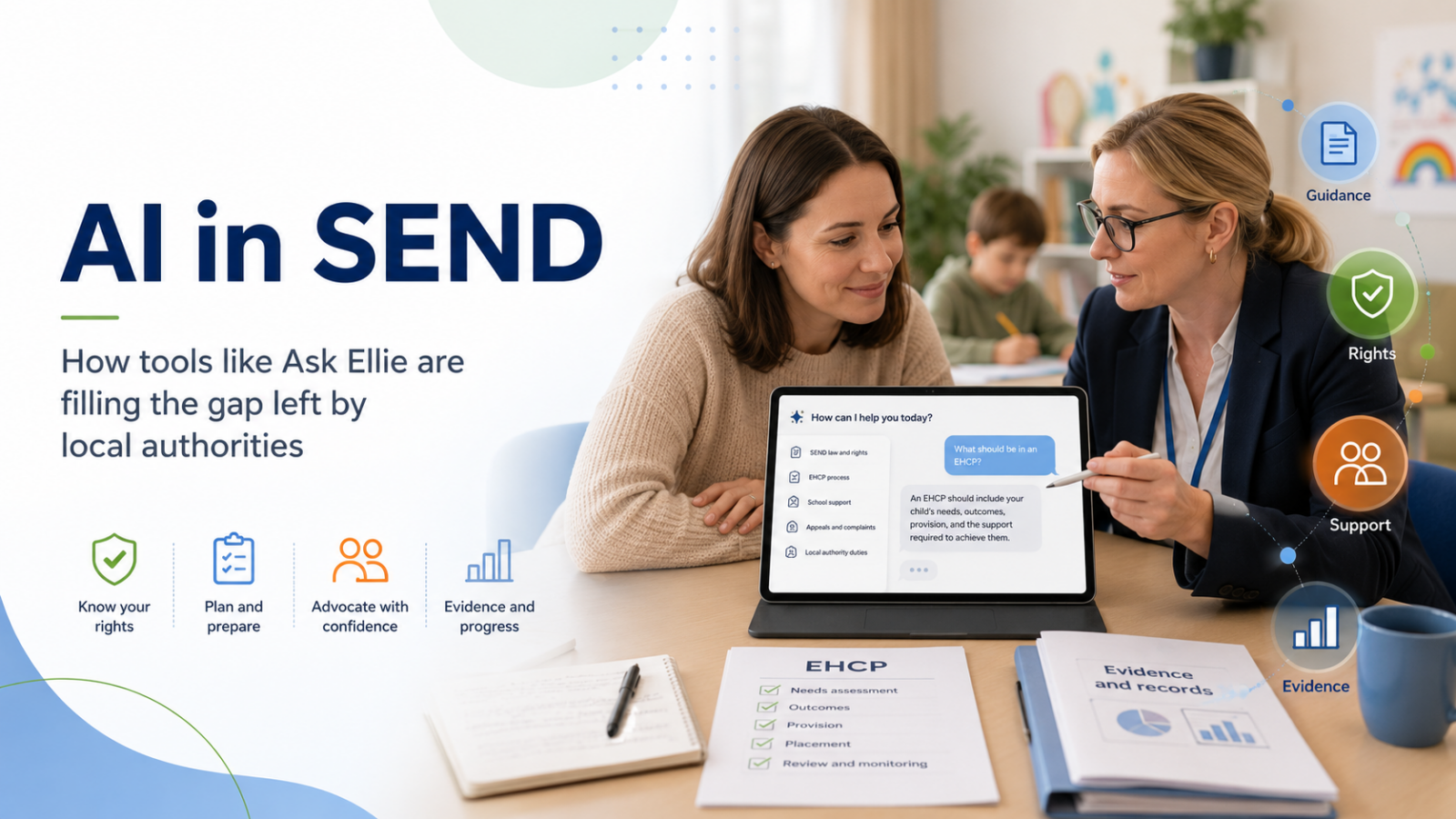
The Special Educational Needs and Disabilities (SEND) framework in the United Kingdom is currently operating under unprecedented strain. Local Authorities (LAs) are overwhelmed by unmanageable caseloads, a reality that is leading to significant, life-altering delays in statutory assessments, tribunal appeals, and the provision of adequate support for the nation’s most vulnerable children. In this rapidly widening void between the government’s statutory duty and the actual delivery of frontline services, technological solutions are rapidly emerging to bridge the gap.
Chief among these educational innovations is the rise of AI-powered legal and advisory assistants. Custom-built generative AI platforms, such as ‘Ask Ellie‘, are providing desperate families and educators with instantaneous, free guidance on highly complex SEND legislation. However, while AI can seamlessly navigate the law, it cannot invent the facts. To secure comprehensive support, this legal technology must be paired with undeniable, longitudinal evidence of a child’s learning journey – which is exactly where holistic digital infrastructures like E.L.A.H.A (Early Learning Assessment and Holistic Approach) become essential.
The Crumbling Local Authority Infrastructure: A Statistical Reality
The crisis within Local Authorities is not a secret; it is heavily documented in government audits, independent reviews, and the Department for Education’s own national statistics. To understand why parents and educators are turning to artificial intelligence and independent digital platforms, one must look at the sheer scale of the systemic bottleneck.
According to the latest data published by the UK Government on the Explore Education Statistics portal (January 2025 release), the demand for special educational support has reached historic highs. As of January 2025, there are 638,745 active Education, Health and Care Plans (EHCPs) in England, representing a massive 10.8% increase from the previous year. Furthermore, in the 2024 calendar year alone, Local Authorities received 154,489 initial requests for an EHC needs assessment—an 11.8% jump compared to 2023.
Against this tidal wave of demand, the statutory infrastructure is buckling. The legal requirement dictates that an EHCP must be finalised within 20 weeks of the initial request. However, official government statistics reveal that in 2024, only 46.4% of new plans were issued within this 20-week deadline. This is a sharp decline from 50.3% in 2023. In practical terms, this means that over half of all families navigating the SEND system are being forced to wait unlawfully long periods for their child to receive basic educational provisions.
The core issues driving this collapse include:
-
Caseworker Shortages: High turnover rates within council SEND departments mean that families rarely have a consistent, dedicated point of contact. This directly leads to lost information, repeated assessments, and fractured communication.
-
Funding Deficits: A staggering number of county councils are currently operating with massive high needs block deficits. This financial black hole forces them to gatekeep resources to balance budgets, rather than distributing support based purely on the individual needs of the child.
-
Statutory Misses: As the government data proves, the legal requirement to finalise an EHCP within 20 weeks is currently missed in over half of all cases nationally.
The Emergence of AI in SEND Law
Historically, when a family faced a rejected EHCP application, a refusal to assess, or a school’s failure to provide specified provision, their options were severely limited. Their only recourse was to retain expensive legal counsel or rely on heavily overstretched charities, such as IPSEA (Independent Provider of Special Education Advice).
Today, artificial intelligence is democratising access to SEND law. Bespoke tools like ‘Ask Ellie‘ are meticulously trained on the intricate details of the Children and Families Act 2014, the SEND Code of Practice, and thousands of historical First-Tier Tribunal outcomes. These accessible platforms allow parents and Special Educational Needs Coordinators (SENCOs) to:
-
Draft highly formal, legally sound complaint letters referencing specific legal statutes and case law.
-
Understand the legal threshold for an EHC Needs Assessment instantly, bypassing LA gatekeeping.
-
Prepare robust legal arguments and working documents for mediation or tribunal hearings.
The paradigm shift is evident when comparing the traditional route to the modern AI-assisted approach:
| Traditional Support Route | AI Assistant Route (e.g., Ask Ellie) |
| Weeks of waiting for charity helpline callbacks. | Instant, 24/7 access to legal interpretations. |
| High legal fees for solicitor consultations. | Free or low-cost automated drafting and advice. |
| Reliance on overwhelmed LA caseworkers for information. | Empowered, independent understanding of statutory rights. |
The Missing Ingredient: Undeniable Longitudinal Evidence
While AI legal assistants are revolutionary in empowering parents to navigate the letter of the law, they present only half of the solution. Securing the right educational support ultimately relies on undeniable, structured evidence of a child’s needs.
Even the most sophisticated, legally articulate AI cannot win an EHCP appeal or overturn a refusal to assess without raw, historical data. Local Authority panels and First-Tier SEND Tribunals do not grant provisions based solely on beautifully written legal letters; they demand a robust paper trail of the “Assess, Plan, Do, Review” cycle. They require proof of the interventions tried, the specific cognitive challenges faced, and a comprehensive overview of the child’s academic and emotional baseline.
The real problem in modern UK education isn’t a lack of pedagogical tools—it is the reality of fragmented systems and disconnected data. When a child moves between different schools or transitions from mainstream education to homeschooling, their vital developmental data is often lost, forcing parents and professionals to start from scratch.
What E.L.A.H.A Offers: The Ultimate Neuro-Affirming Infrastructure
This critical gap in data continuity is exactly where platforms like E.L.A.H.A become an indispensable asset. E.L.A.H.A (Early Learning Assessment and Holistic Approach) provides the comprehensive digital tools necessary to bridge the communication gap between schools, parents, students, and external SEND services. It is explicitly built to support neuro-affirming education operations by enabling educators and families to effortlessly track learning progress, document interventions, and maintain comprehensive, strength-based records over time.
A Comprehensive Platform Built for UK Schools
For headteachers, trust leaders, and SENCOs, E.L.A.H.A brings together fragmented school operations into one unified, UK-focused system. Crucially, the platform is KCSIE 2023 ready and deeply integrated with automated DfE Census reporting. E.L.A.H.A allows school leadership to seamlessly manage:
-
School Management & HR: Effortlessly managing students, timetables, and daily operations, while providing a secure infrastructure for safer recruitment, staff onboarding, and CPD tracking.
-
Assessments and Progress: Mapping academic progress alongside early years pathways and specialised SEN development tracking from a centralised, intuitive dashboard.
-
SEN and Safeguarding: Maintaining highly secure records of inclusion-led student support plans, targeted interventions, well-being observations, and critical safeguarding concerns. By keeping this data unified, SENCOs can easily generate the reports required for external LA audits and EHCP applications.
-
School Marketplace: Secure, Stripe-verified school-scoped storefronts built for protected parent transactions (such as uniform purchases or school trips) within the learner’s specific school context.
Free Support & Resources for Home Educating Families
Recognising that mainstream schooling is not the right fit for every child—particularly those with severe school anxiety, Autism, or complex SEND—E.L.A.H.A provides powerful, free digital management tools for the home education sector. Whether a child is home-educated full-time or recovering from a difficult school experience, E.L.A.H.A empowers families with:
-
A Full Learning Workspace: Allowing parents to easily compile weekly learning logs, track core subjects (English, Maths, Science), and note the student’s daily reflections.
-
Evidence of Learning: Parents and students can upload project portfolios and instantly generate comprehensive “Local Authority Review Packs” to satisfy annual elective home education (EHE) checks.
-
Future Pathway Planning: Structured tools designed to help older students prepare for post-16 college transitions, Functional Skills qualifications, private GCSE alternatives, and vocational pathways.
The “Shared Child Journey”
Perhaps the most revolutionary aspect of E.L.A.H.A is its commitment to the “Shared Child Journey.” If a child transitions from school enrollment to home education, or later moves into a further education college setting, E.L.A.H.A ensures that their complete educational history, SEN assessments, and learning evidence move seamlessly with them. By keeping the child’s journey unified, parents, school leaders, and external clinical professionals can collaborate perfectly at every single transition point, completely eradicating the risk of data loss.
Furthermore, through E.L.A.H.A Extended, the platform fosters a massive community forum, connecting over 200 topics across 20+ subjects. Parents and educators can connect to share strategies on child development, adequate nutrition, effective disciplinary measures, and the careful balance of technology in the classroom.
The Ultimate Synergy: AI Legal Strategy Meets Irrefutable Data
The future of SEND advocacy in the United Kingdom relies on a dual approach. When families use platforms like E.L.A.H.A alongside legal AI tools, they create an airtight case.
The workflow is incredibly potent:
-
The parent or SENCO utilises E.L.A.H.A’s daily tracking tools to build a rich, contextualised history of the student’s educational journey, clearly highlighting the compensatory mechanisms the student employs, the interventions that have failed, and the strength-based assessments of their unique cognitive architecture.
-
When the Local Authority pushes back or delays the statutory process, the family turns to tools like ‘Ask Ellie’.
-
The AI provides the immediate legal framework and drafts the necessary legal correspondence.
-
E.L.A.H.A automatically provides the undeniable, longitudinal evidence required by Local Authorities and tribunals to authorise and mandate support.
By marrying expert legal AI with flawless educational data tracking, parents are no longer at the mercy of caseworker shortages or council funding deficits.
Empowering the Next Generation
Ultimately, bridging the gap left by struggling Local Authorities requires more than just patience; it requires smart, integrated technology. The transition from a deficit-focused, bottlenecked educational system to a neuro-affirming, proactive one demands robust digital infrastructure.
While AI democratises the complex world of SEND law, E.L.A.H.A provides the operational framework that values holistic intelligence, ensuring that every dyslexic, autistic, or neurodivergent learner has their journey properly documented and celebrated. Together, these technologies guarantee that every child is finally seen, supported, and positioned to thrive in the modern world.
References
-
Department for Education (January 2025). Education, health and care plans. Explore Education Statistics. GOV.UK. Available at: Explore Education Statistics GOV.UK
-
E.L.A.H.A Platform Offerings & Community. Early Learning Assessment and Holistic Approach. Available at: www.elaha.uk