

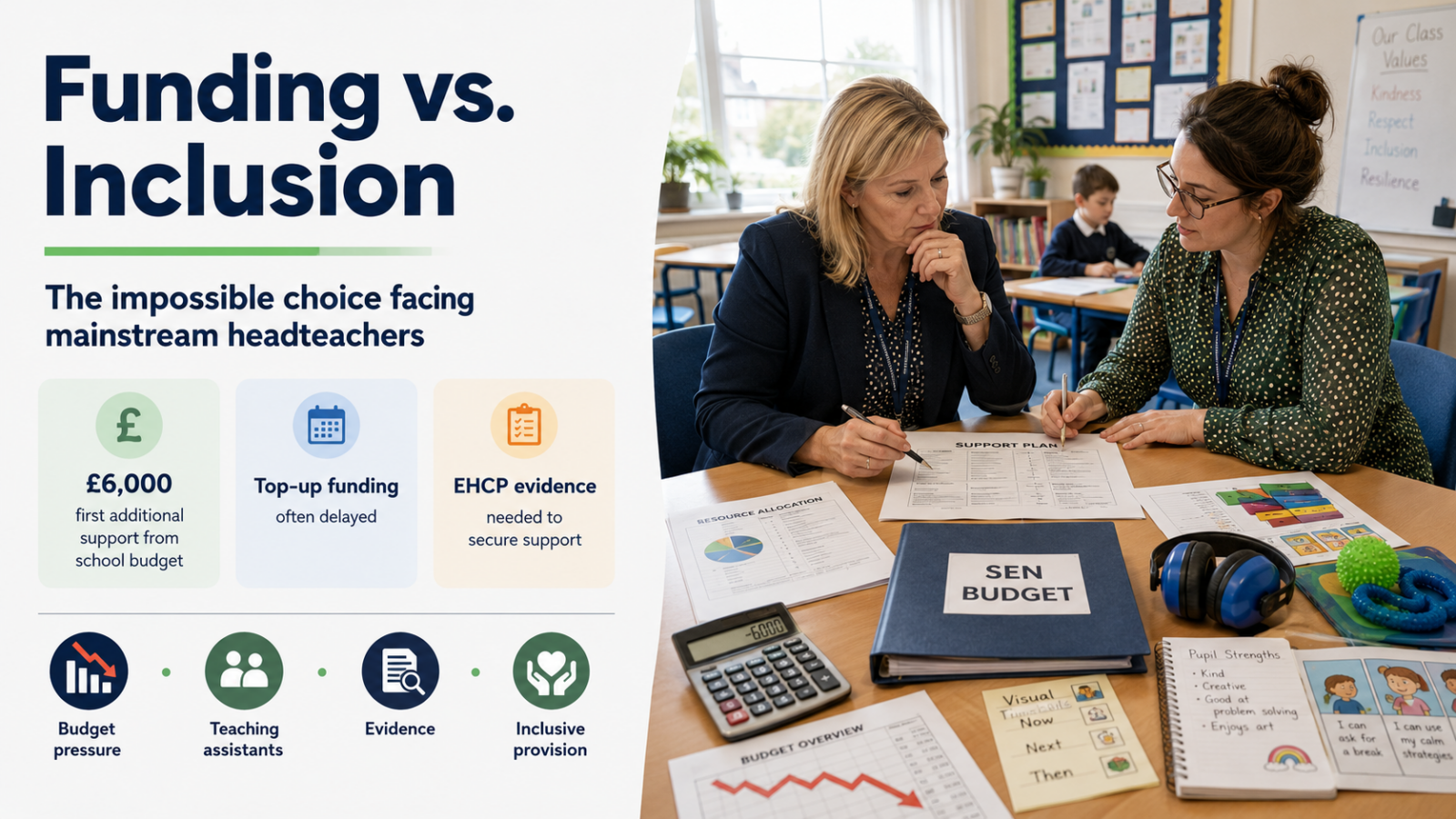
In the United Kingdom’s education sector, “inclusion” is a core moral and statutory imperative. Mainstream schools are expected to welcome, support, and elevate students across the full spectrum of Special Educational Needs and Disabilities (SEND). However, this imperative is currently colliding with a harsh, unyielding financial reality. Chronic underfunding has forced mainstream Headteachers into an impossible corner, where they must choose between balancing the school’s core budget and providing the necessary, statutory care for their most vulnerable pupils.
The Mathematics of the Crisis
The SEND funding formula in England is structurally misaligned with the reality of inclusive classrooms. Under the current system, mainstream schools are expected to fund the first £6,000 of “additional support” for a child with SEND from their notional SEN budget – a budget that is frequently absorbed by general school running costs – before they can even apply for “top-up” high-needs funding from their Local Authority (LA).
When LAs, which are themselves grappling with historic high-needs budget deficits, deny or severely delay the issuance of Education, Health and Care Plans (EHCPs), schools are left to shoulder the entire financial burden. The consequences of this systemic shortfall are severe:
- Decimated Support Staff: Schools are forced to reduce vital Teaching Assistant (TA) roles, spreading remaining staff dangerously thin and leaving neurodivergent pupils without the necessary 1:1 support.
- “Ghost Inclusion”: Children are physically present in mainstream classrooms but lack the sensory tools, specialised software, or targeted environment modifications required to access the curriculum.
- Operational Burnout: Senior leadership teams spend excessive, non-billable hours fighting bureaucratic bottlenecks rather than focusing on pedagogical innovation.
The Cost of Inaction: Evidence vs. Compliance
A critical driver of this funding crisis is the evidentiary burden placed on schools. To access high-needs funding or secure an EHCP, schools must provide substantial, longitudinal evidence that the child’s needs cannot be met through standard resources.
However, many schools operate with fragmented, manual, or paper-based systems. When a child’s progress is not being tracked in a structured, data-rich way, Headteachers struggle to prove the impact of their interventions to Local Authority funding panels. This creates a vicious cycle: because the school cannot effectively “prove” the need or the failure of current adjustments, funding is denied, which prevents the school from securing the very resources the child requires.
Moving from Budgetary Crisis to Operational Efficiency
Headteachers cannot independently solve the macro-economic funding crisis, but they can revolutionise how they track, deploy, and evidence their existing resources. To survive in this climate, schools must move away from retrospective, resource-heavy paperwork and adopt proactive, data-driven operational infrastructures.
This is where advanced educational technology, such as E.L.A.H.A (Early Learning Assessment and Holistic Approach), serves as a vital operational partner for schools. By streamlining the evidence-gathering process, such platforms help schools maximise the impact of their SEN budget:
- Continuous, Automated Tracking: Instead of staff spending hundreds of hours on retrospective evidence drives for EHCP applications, E.L.A.H.A provides automated, longitudinal tracking of interventions in one central, accessible dashboard.
- Evidence-Based Resource Allocation: The platform provides data-driven insights that identify exactly which environmental modifications or pedagogical strategies work for specific neurodivergent profiles. This ensures that the limited SEN budget is spent on effective strategies rather than “trial-and-error” interventions.
- Streamlined Statutory Compliance: By maintaining an indisputable record of the “Assess, Plan, Do, Review” cycle, schools can present Local Authorities with comprehensive, audit-ready packs, significantly reducing the time spent on administrative appeals.
Inclusion as a Data-Driven Commitment
Inclusion should not bankrupt our schools. The current “impossible choice” facing Headteachers is largely a result of archaic, siloed administrative systems that fail to capture the complex reality of SEND provision.
By leveraging neuro-affirming digital infrastructures, Headteachers can bridge the gap between their moral duty and their fiscal constraints. When schools can prove the efficacy of their support, ensure statutory compliance without excessive administrative load, and identify the exact needs of their learners through granular data, they create a more sustainable model for inclusion. The path forward requires a departure from legacy administrative burdens and an investment in operational transparency – ensuring that every pound spent on SEND is a pound that directly supports a child’s ability to thrive.
References & Sources
- Department for Education (2025). Education, health and care plans: reporting on the 20-week statutory deadline. Statistical releases on the current state of EHCP issuance and the high-needs budget gap.
- E.L.A.H.A Platform Architecture. Early Learning Assessment and Holistic Approach. Providing the digital infrastructure for neuro-affirming progress tracking and efficient SEN evidence-logging for mainstream and specialist settings. Available at: www.elaha.uk
- Institute for Fiscal Studies (2024). School funding in England: trends and challenges. Analysis of the notional SEN budget and the increasing fiscal pressure on mainstream schools to provide high-needs support.
- National Association of Head Teachers (NAHT) (2025). The SEND Funding Crisis: A Report on School Capacity and Resourcing. Detailing the impact of LA high-needs deficits on Teaching Assistant employment and school budget viability.
Special Needs Jungle (2024). The high-needs funding gap: Why mainstream schools are being asked to do the impossible. An analysis of the £6,000 threshold and the bureaucratic barriers to accessing LA top-up funding.