
The Education, Health and Care Plan (EHCP) was introduced by the Children and Families Act in 2014 with a noble, transformative ambition: to create a cohesive, multi-agency safety net for children with the most complex Special Educational Needs and Disabilities (SEND). The goal was to replace the old Statement of SEN with a system that placed the child at the centre of a seamless integration between health, social care, and education. Fast forward a decade, and that original vision has largely evaporated.
Today, the latest Department for Education (DfE) statistics paint a dire, undeniable picture of a system in freefall. Across the United Kingdom, families, teachers, and school leadership teams are trapped in a bureaucratic bottleneck of catastrophic proportions. With massive backlogs, chronic delays, and exponentially escalating tribunal appeals, a critical question must be asked: Is the statutory framework surrounding EHCPs broken beyond repair, or can educational technology fundamentally salvage it?
The Statistical Reality of the EHCP Crisis
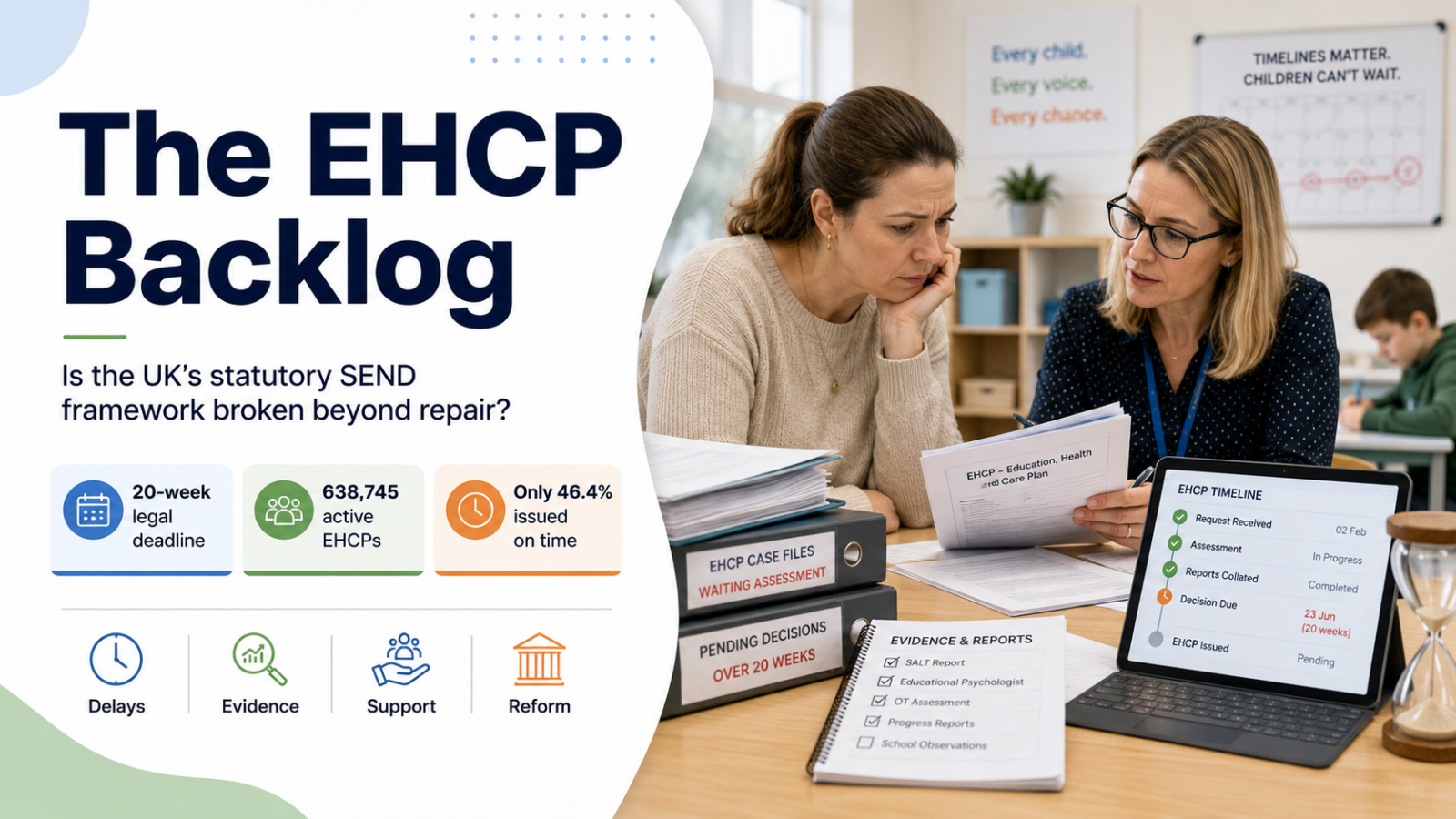
To understand the sheer scale of the crisis, one must compare the legal foundation of the SEND system against its operational reality. The statutory deadline for a Local Authority (LA) to finalise an EHCP is strictly set at 20 weeks. This timeframe was explicitly legislated to ensure that vulnerable children are not left languishing in unsuitable environments without appropriate educational provision. However, in many regions across the UK, this legal target is treated more as an administrative suggestion than a statutory obligation.
Recent government statistics published on the Explore Education Statistics portal in January 2025 confirm the absolute severity of the backlog. According to the DfE data, as of January 2025, there are a staggering 638,745 active EHCPs in England alone – an enormous 10.8% increase from the previous year. Demand is at an all-time high, with Local Authorities processing 154,489 initial requests for EHC needs assessments in the 2024 calendar year alone.
Against this unprecedented demand, statutory compliance has entirely collapsed. The government’s own data reveals that in 2024, only 46.4% of new plans were issued within the mandatory 20-week timeframe – a sharp, alarming drop from the already failing 50.3% recorded in 2023. In practical terms, this means that more than half of all families navigating the SEND system are unlawfully denied timely support. They are caught in a prolonged administrative limbo that actively harms the child’s developmental trajectory, sometimes waiting well over a year for basic legal recognition of their needs.
The Devastating Human Cost
Statistics and percentages alone cannot capture the lived experience of families trapped in the SEND backlog. The human cost of these delays is devastating, often causing irreparable damage to a child’s relationship with learning. The crisis manifests in three distinct, highly damaging ways:
1. Lost Education and the Rise of EBSA
Children are frequently left out of school or languishing in mainstream environments without the dedicated support – such as 1:1 teaching assistants, occupational therapy, or speech and language therapy – they legally require. For neurodivergent children, particularly those with Autistic Spectrum Disorder (ASD), severe ADHD, or profound Dyslexia, mainstream classrooms without proper adjustments can be highly traumatising sensory and cognitive environments.
Extended delays in securing support frequently lead to Emotionally Based School Avoidance (EBSA). Educational psychologists define EBSA not as truancy or a behavioural defiance, but as a severe stress response to an environment that is failing to meet the child’s neurodevelopmental needs. The child often wants to be in school but is overwhelmed by anxiety and distress. Without an EHCP in place to mandate adjustments, these vulnerable students are eventually pushed entirely out of the education system, losing months or years of academic progress.
2. Parental Burnout and Isolation
Families are forced into adversarial, exhausting battles with Local Authorities, navigating complex bureaucracies, mandatory mediations, and SEND tribunals simply to secure basic educational rights. Parents are often required to act as full-time project managers, desperately coordinating between conflicting medical professionals, overwhelmed schools, and silent council SEND departments. The mental health toll on parents and carers is profound. Navigating the failing SEND system operates as an unpaid, highly stressful full-time job, frequently leading to severe psychological burnout, relationship breakdown, and significant employment loss for parent-carers.
3. Financial Strain and the Broken Tribunal System
Perhaps the most egregious failure of the current framework is the financial waste associated with local council gatekeeping. Local Authorities spend millions of pounds of taxpayer money fighting parents in SEND tribunals – cases which the councils routinely lose – diverting crucial funds away from actual frontline provision.
Recent data tracking Ministry of Justice SEND tribunal statistics reveal a highly dysfunctional system. Registrations have surged to unprecedented highs of approximately 25,000 appeals annually. The tribunal upholds appeals in favour of families in a staggering 95% to 96% of all decided cases. This virtually guaranteed win rate proves that Local Authorities are routinely making unlawful or fundamentally flawed decisions at the initial application stage. It suggests a systemic reliance on “gatekeeping by delay,” counting on parents to simply give up rather than adhering to statutory SEND law.
Systemic Reforms: What Actually Needs to Change?
It is abundantly clear that minor policy tweaks and minor funding injections will not salvage the EHCP framework. Systemic, root-and-branch reform is urgently required. The necessary shifts are fundamental to how we view neurodiversity and how we manage educational data.
| Current System Failing | Required Systemic Reform |
| Fragmented, paper-based evidence gathering across disparate agencies. | Unified, digital tracking of interventions and progress is mapped long before an application is submitted. |
| Deficit-focused assessments that emphasise only what a child cannot do or has failed at. | Neuro-affirming profiling that highlights cognitive strengths alongside specific support needs. |
| Adversarial gatekeeping of high-needs funding based on arbitrary local policies. | Transparent, data-driven funding allocation based on indisputable, longitudinal legal evidence. |
The Root Cause and the “Assess, Plan, Do, Review” Cycle
The chaotic nature of the EHCP process is heavily exacerbated by chronically poor record-keeping at the institutional level. Local Authorities and SEND panels are strictly bound by evidence thresholds. Before an EHCP assessment is even considered by a council, a school must demonstrate that they have exhausted its own delegated SEND budgets and implemented a “graduated response.” Schools and families often struggle to compile the stringent “Assess, Plan, Do, Review” cycles required to prove that lower-level interventions have been exhausted.
When a child transitions between different educational settings, moves to a new council borough, or transitions from mainstream education to Elective Home Education (EHE), their vital developmental data is almost always lost. New teachers and LAs are forced to start the graduated response entirely from scratch, erasing the child’s prior history of failed interventions. It is exactly this fundamental lack of data continuity that gives Local Authorities the bureaucratic leverage to reject initial EHCP requests under the guise of “insufficient evidence.”
The Role of E.L.A.H.A in Bridging the Gap
In the rapidly widening void between the government’s statutory duty and the actual delivery of frontline services, educational technology is emerging as the most powerful tool for systemic reform. E.L.A.H.A (Early Learning Assessment and Holistic Approach) offers a vital lifeline in this broken system. By utilising E.L.A.H.A., educators and families can organically build a robust, structured digital portfolio of a child’s learning journey over time.
The platform directly solves the evidence-gathering crisis by allowing for:
-
Consistent logging of evidence, adjustments, and the outcomes of specific interventions. This perfectly maps onto the mandatory “Assess, Plan, Do, Review” cycle required by the SEND Code of Practice, removing the heavy administrative burden from overwhelmed classroom teachers.
-
Clearer collaboration between schools, parents, and consented professionals, breaking down the silos that currently delay applications. When educational psychologists, independent legal AI tools like ‘Ask Ellie’, or speech and language therapists become involved, they have immediate, secure access to years of highly contextualised data.
-
A shift towards strengths-based indicators, ensuring the final EHCP reflects a holistic view of the child. Rather than defining a child purely by their deficits, school anxiety, or academic failures, the platform meticulously measures their divergent thinking and cognitive advantages.
A Deep Dive into E.L.A.H.A’s Full Ecosystem
To truly understand how E.L.A.H.A repairs the broken SEND framework, it is crucial to examine the full scope of what the platform offers to schools, parents, students, and support services. It is not merely a tracking app; it is an entirely unified, neuro-affirming educational ecosystem built explicitly for the UK sector.
For Mainstream and Special Schools
For headteachers, Multi-Academy Trust (MAT) leaders, and SENCOs, E.L.A.H.A consolidates highly fragmented school operations into one single, KCSIE 2023-compliant hub. It offers a complete School Management and HR suite, streamlining daily operations, timetabling, safer recruitment protocols, and staff Continuing Professional Development (CPD) tracking.
Crucially, the platform features an advanced Assessments and Progress module. This allows SENCOs to map academic progress simultaneously against early years pathways and highly specialised SEND development tracking. Integrated with a secure SEN and Safeguarding core, schools can maintain highly protected records of inclusion-led student support plans, targeted interventions, and critical safeguarding observations. Because this data is unified and easily exportable, schools can generate undeniable, comprehensive reports required for external LA audits and successful EHCP applications in a matter of minutes, saving hundreds of administrative hours. Additionally, E.L.A.H.A provides a secure School Marketplace, giving parents a Stripe-verified, school-scoped storefront for essential transactions like uniform purchases or trip fees.
For Elective Home Education (EHE) Families
The EHCP crisis has driven thousands of families out of the mainstream system entirely, often due to severe EBSA or a complete failure by the LA to provide adequate, safe support. E.L.A.H.A recognises this reality by offering powerful, free digital management tools specifically designed for the home education sector.
Parents who are home educating can access a Full Learning Workspace, enabling them to compile weekly learning logs, track core subjects like English, Maths, and Science, and document the student’s daily emotional reflections. As the child progresses, parents can seamlessly build digital project portfolios, instantly generating comprehensive “Local Authority Review Packs.” These packs satisfy annual EHE checks and safeguard the family from invasive, unwarranted council oversight. Furthermore, the platform features robust Future Pathway Planning tools, helping older neurodivergent students prepare for post-16 college transitions, Functional Skills qualifications, private GCSE alternatives, and vocational apprenticeships.
The “Shared Child Journey” and Community Integration
At the absolute core of E.L.A.H.A is the revolutionary concept of the “Shared Child Journey.” If a child transitions from school enrollment to home education, or later moves into a Further Education college setting, E.L.A.H.A ensures that their complete educational history, SEND assessments, and learning evidence move seamlessly with them. This completely eradicates the risk of data loss and ensures that no child ever has to start the painful EHCP evidence-gathering process from scratch again.
Furthermore, through the E.L.A.H.A Extended module, the platform fosters a massive community forum, connecting over 200 topics across 20+ subjects. It serves as a vital support network where parents, educators, and clinical professionals can openly share strategies on child development, neurodiversity, and legislative navigation, effectively bypassing the isolation created by failing Local Authorities.
Returning Control to Families and Educators
The statutory framework surrounding the EHCP is undeniably buckling under the weight of chronic underfunding, staff shortages, and systemic inefficiencies. While legislation must inevitably change at the government level to hold Local Authorities accountable, platforms like E.L.A.H.A give control back to schools and parents today. They ensure that when an EHCP application or tribunal appeal is submitted, the evidence is undeniable, meticulously organised, and ready for immediate assessment.
We can no longer afford to wait for Parliament to fix a system that routinely leaves more than half of the country’s most vulnerable children without basic, timely support. By adopting unified, neuro-affirming digital infrastructures like E.L.A.H.A – and pairing them with an empowered understanding of SEND law—we can guarantee that every child’s learning journey is perfectly documented, their needs are legally supported, and their unique potential is fully realised.
References
-
Department for Education (January 2025). Education, health and care plans. Explore Education Statistics. GOV.UK. Official government statistics documenting the rise to 638,745 active EHCPs and the drop to a 46.4% success rate for the 20-week statutory issuance deadline.
-
Ministry of Justice & Administrative Justice Council (2024/2025). SEND Tribunal Statistics and Decision-Making Reports. Documenting approximately 25,000 registered appeals and a consistent 95%-96% tribunal win rate in favour of appellants (families).
-
Rae, T. (2020) / Milton Keynes SEND Guidance (2024). Emotionally Based School Avoidance (EBSA) Guidance. Documenting EBSA as a pattern of absence rooted in anxiety and unmet special educational needs, rather than simple truancy.
-
E.L.A.H.A Platform Offerings & Ecosystem. Early Learning Assessment and Holistic Approach. System architecture and module frameworks for mainstream, SEND, and Elective Home Education tracking. Available at: www.elaha.uk